



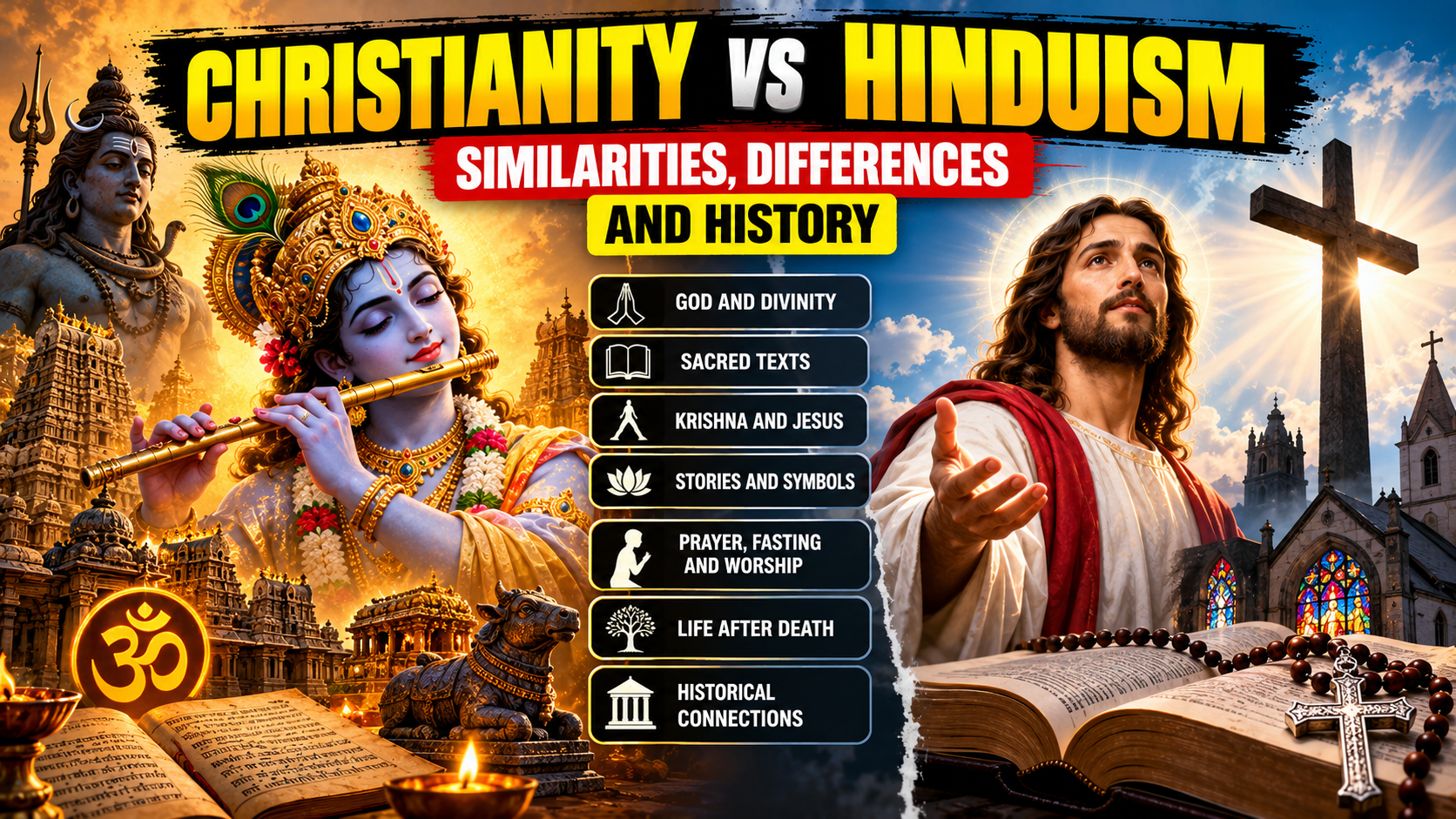
Christianity and Hinduism are two influential religious traditions with millions of followers around the world. Although they developed in different historical and cultural settings, both explore profound questions about God, human life, morality, suffering, spiritual growth, and what happens after death.
Some people notice similarities between Hindu stories and Christian teachings. They point to concepts such as the Trinity and the Trimurti, stories of divine figures, sacred symbols, fasting, prayer, miracles, and beliefs about the future.
But how similar are these religions? Did one influence the other, or do some similarities reflect themes that appear in different religious traditions?
In this article, we will compare Christianity and Hinduism, examine their similarities and differences, and distinguish historical evidence from speculation.
1. The Origins of Christianity and Hinduism
Hinduism: A diverse tradition with ancient roots
Hinduism developed over many centuries in the Indian subcontinent. Unlike religions associated with a single historical founder, Hinduism encompasses numerous traditions, philosophies, scriptures, and forms of worship.
Its historical roots include the Vedic tradition, while later developments incorporated a wide range of philosophical schools, devotional movements, temple practices, and regional traditions.
Important Hindu texts include the Vedas, Upanishads, Bhagavad Gita, Ramayana, and Mahabharata, along with the Puranas and many other works.
Hindu traditions include devotion to deities such as Vishnu, Shiva, and Devi, as well as philosophical approaches that understand ultimate reality in different ways. Some Hindus emphasise one supreme deity, while other traditions express the divine through multiple deities or focus on an impersonal ultimate reality.
Christianity: A religion centred on Jesus Christ
Christianity emerged in the first century CE in the eastern Mediterranean, within the Jewish religious world of Roman Judea.
Jesus of Nazareth is the central figure of Christianity. Christians believe that his life, teachings, death, and resurrection have unique significance for humanity and its relationship with God.
The Bible is Christianity’s sacred scripture. It consists of the Old Testament and the New Testament, although the precise composition of the Old Testament differs among Christian traditions.
Christianity subsequently spread throughout the Roman Empire and beyond, eventually developing into many traditions, including Catholicism, Eastern Orthodoxy, and Protestantism.
An important historical distinction: Hindu traditions have ancient roots, while Christianity emerged as a distinct religious movement in the first century CE. This chronology alone does not prove that Christianity copied Hindu teachings.
2. God in Hinduism and Christianity
The nature of God is one of the most important subjects in comparing the two religions.
Hindu perspectives on God
Hinduism contains a wide range of theological perspectives.
Some traditions worship Vishnu, Shiva, Devi, or another deity as the supreme reality. Other Hindu philosophies emphasise Brahman, the ultimate reality that underlies existence. Some approaches understand the divine as personal, while others describe ultimate reality in ways that go beyond ordinary distinctions between person and object.
Consequently, it is misleading to describe every Hindu as believing exactly the same thing about God.
The Christian understanding of God
Most Christian traditions teach that there is one God who exists eternally as three distinct persons: the Father, the Son, and the Holy Spirit. This doctrine is called the Trinity.
Christians do not ordinarily understand the three persons as three separate gods. Rather, the Trinity expresses their belief in one God in three persons.
Are the Trinity and the Trimurti the same?
The Hindu Trimurti is commonly associated with Brahma, the creator; Vishnu, the preserver; and Shiva, the destroyer or transformer.
At first glance, the Trimurti may appear similar to the Christian Trinity because both involve three divine figures or persons in discussions of the divine.
However, the concepts are fundamentally different.
The Christian Trinity describes one God in three persons. The Trimurti describes three major deities associated with cosmic functions in certain Hindu traditions. Hindu traditions do not all assign the Trimurti the same theological importance.
Therefore, the two concepts can be compared, but they should not be treated as identical doctrines.
3. Sacred Texts and Religious Teachings
Both religions preserve extensive bodies of sacred literature that influence worship, ethics, philosophy, and everyday life.
| Hinduism | Christianity |
|---|---|
| Vedas | Bible, including the Old and New Testaments |
| Upanishads | Biblical writings that discuss God, humanity, and spiritual life |
| Bhagavad Gita | Gospels and other New Testament writings |
| Ramayana and Mahabharata | Biblical narratives and teachings |
| Puranas and other traditional texts | Christian theological and devotional writings |
These texts are not directly equivalent in purpose or authority. Each developed within its own historical and religious context.
The Bhagavad Gita, for example, explores duty, spiritual knowledge, devotion, and liberation through a dialogue between Krishna and Arjuna. The Gospels recount Jesus’ ministry and teachings and present the Christian understanding of his significance.
Both traditions use stories, teachings, and devotional literature to help followers reflect on how to live, but their scriptures express distinct religious worldviews.
4. Krishna and Jesus: Are Their Stories Similar?
Comparisons between Krishna and Jesus are among the most widely discussed topics in online articles about Hinduism and Christianity.
Both are central figures in their respective religious traditions, and their stories contain themes involving divine significance, extraordinary events, devotion, and the struggle between good and evil.
However, similarities need to be examined carefully.
Birth stories
In Christian scripture, Jesus’ birth is associated with Mary, who conceives through the Holy Spirit. The Gospel of Matthew also recounts the visit of the Magi, who follow a star, and describes King Herod’s attempt to kill the infant Jesus.
Krishna’s birth story, preserved in Hindu traditions, describes his parents Devaki and Vasudeva. His birth takes place under the threat of King Kamsa, who fears a prophecy concerning the child.
There are thematic parallels involving a threatened child and a ruler who fears the child’s future significance. But the narratives are not identical.
A crucial correction: Krishna’s traditional birth story should not simply be described as the same as Jesus’ virgin birth. Krishna’s story involves Devaki and Vasudeva, while the Christian account describes Jesus’ conception through the Holy Spirit.
The similarities are worth studying, but they do not by themselves prove that one story was copied from the other.
Miracles and divine actions
Christian texts describe Jesus healing the sick, restoring sight, raising the dead, and performing other miracles.
Hindu scriptures also contain accounts of extraordinary acts by Krishna and other divine figures. Krishna’s stories include miraculous events, the defeat of powerful adversaries, and the protection of devotees.
Both traditions use extraordinary events to communicate religious meaning. However, the stories differ in their details, theology, and narrative purpose.
Divine purpose
Christianity teaches that Jesus came to reconcile humanity with God and that his death and resurrection are central to salvation.
In Hindu traditions, Krishna’s role is understood in different ways, including as an avatar of Vishnu who restores dharma and guides devotees.
Both figures have profound religious significance, but their roles should not be reduced to a single shared explanation.
5. Krishna and Jesus: The White Horse Prophecy
Another commonly discussed similarity concerns the image of a divine figure associated with a white horse and a future restoration of justice.
In Hindu traditions, Kalki is described as a future avatar of Vishnu who will appear at the end of the current age, according to traditional accounts of cosmic time. Depictions commonly associate Kalki with a horse and a sword.
In the New Testament’s Book of Revelation, chapter 19, a figure identified with Christ appears riding a white horse. The passage describes a heavenly warrior who judges and makes war in righteousness, with a sharp sword coming from his mouth. <Cite refs={[“turn454178search0″,”turn454178search3”]}/>
These images can be compared because both include a powerful figure associated with divine judgment and the defeat of evil.
However, there are important differences. The Kalki tradition belongs to Hindu understandings of cyclical cosmic time, while the Christian passage belongs to the apocalyptic imagery of Revelation.
A similarity in imagery does not establish that the two traditions describe the same figure or that one account was borrowed from the other.
6. Bells, Lamps, and Sacred Symbols
Religious worship often uses objects that help people focus their attention, express devotion, and mark sacred spaces.
Bells
Bells are used in many Hindu temple rituals. In some traditions, ringing a bell marks the beginning of worship and helps focus the devotee’s attention.
Bells are also used in Christian churches for purposes such as calling people to worship, marking services, and signalling important occasions.
The use of bells in both settings is a genuine similarity in religious practice, although the meanings and rituals associated with them can differ.
Lamps and candles
Lamps play an important role in Hindu worship. In many traditions, the lighting of a lamp represents light, auspiciousness, and the presence of the divine. The ritual of arati often involves offering light to a deity.
Candles are also used in many Christian traditions, including prayer, worship, remembrance, and certain liturgical ceremonies.
Both practices use light symbolically, but they developed within distinct religious settings.
Crosses and Hindu religious symbols
The cross is the central symbol of Christianity, particularly because of its connection with Jesus’ crucifixion and the Christian understanding of salvation.
Hindu traditions use a variety of sacred symbols, including the Om symbol, the trishula associated with Shiva, and the vel associated with Murugan. These symbols have their own histories and religious meanings.
The cross, trishula, and vel should not be considered interchangeable simply because they are all recognisable religious symbols.
7. Fasting, Prayer, and Meditation
Fasting and spiritual discipline are found in both Hinduism and Christianity.
Hindu practices
Hindu observances vary widely. Some devotees fast on particular days, during festivals, or as part of vows. Prayer, meditation, mantra recitation, yoga, and devotional singing are also important in many traditions.
The purpose may include spiritual discipline, devotion, self-control, reflection, or preparation for worship.
Christian practices
Many Christians observe fasting during Lent or on other designated days. Prayer, reading scripture, worship, contemplation, and acts of charity are central to Christian spiritual life.
Different Christian denominations understand and practise fasting in different ways.
What do the similarities mean?
Both religions recognise that spiritual life may involve discipline, prayer, reflection, and devotion.
Yet the presence of fasting or meditation in both traditions does not prove a direct historical connection. These practices can develop independently in different societies and may serve different religious purposes.
8. The Role of Angels and Other Spiritual Beings
Christian scripture includes angels who deliver messages, protect or guide people in particular narratives, and carry out divine purposes.
Hindu traditions include many categories of spiritual beings, such as devas and other celestial figures. Their roles vary across scriptures and schools of thought.
The categories are not identical. Hindu devas, for example, should not simply be described as equivalent to Christian angels. They occupy different places in their respective religious cosmologies.
The stories involving these beings also differ. Comparisons can help readers understand religious ideas, but they should not erase the differences between the traditions.
9. Life After Death: Salvation, Karma, and Rebirth
One of the most important differences between Hinduism and Christianity concerns the nature of human existence and the ultimate spiritual goal.
Hindu perspectives
Many Hindu traditions teach karma, the relationship between actions and their consequences, and samsara, the cycle of birth, death, and rebirth.
Moksha refers to liberation from samsara. Different Hindu philosophical traditions explain the nature of liberation and the relationship between the individual self, the divine, and ultimate reality in different ways.
Some Hindu traditions emphasise devotion to a personal God, while others emphasise spiritual knowledge, meditation, or other paths.
Christian perspectives
Christianity generally teaches that human beings live one earthly life and that their ultimate destiny involves judgment and a relationship with God.
Christians place central importance on salvation through God’s grace, with different traditions explaining the relationship between faith, works, sacraments, and salvation in different ways.
Heaven, resurrection, and eternal life are important concepts in Christian teaching.
The key difference
Hindu traditions commonly include rebirth and liberation from the cycle of existence. Christianity generally does not teach reincarnation and instead emphasises resurrection and eternal life.
These are substantial theological differences, even though both religions address human suffering, moral responsibility, and the hope of a reality beyond ordinary earthly life.
10. Did Christianity Learn Its Teachings from Hinduism?
This is the central historical question raised by many online comparisons.
Because Hindu traditions have ancient roots and some stories appear superficially similar to Christian narratives, some writers suggest that Jesus or early Christian teachers travelled to India and adopted Hindu teachings.
Such ideas are sometimes presented as established historical facts. However, there is no reliable historical evidence demonstrating that the central teachings of Christianity were copied from Hinduism in the way these claims suggest.
Christianity emerged within the Jewish world of the first century CE. Its earliest texts and theological ideas developed in relation to Jewish scripture, beliefs, and the historical setting of the Roman Empire.
India and the Mediterranean world were not completely isolated from one another. Trade routes connected different regions, and cultural exchange between societies occurred over long periods. This makes historical contact a reasonable subject for research, but the possibility of contact is not proof that a particular religious teaching was borrowed.
To establish direct influence, historians would need evidence such as identifiable texts, credible accounts of contact, chronological connections, or demonstrable transmission of specific ideas.
Similarities between religious stories can be important clues for research, but they are not enough on their own to establish a historical connection.
11. Christianity in India: An Important Historical Connection
Christianity has a long history in India, particularly in Kerala.
According to the tradition of the Saint Thomas Christians, the apostle Thomas arrived in India in the first century CE and established Christian communities. This is an important tradition within Indian Christianity.
The precise details of Thomas’s journey are debated by historians, and the earliest firm documentary evidence for Indian Christian communities is later than the traditional date of his arrival.
What is clear is that Christianity has been part of India’s religious landscape for many centuries. Indian Christian communities developed distinctive liturgical, linguistic, and cultural traditions while maintaining connections with wider Christian networks.
This history demonstrates that Christianity and Indian society have interacted over a long period. It does not, by itself, prove that Christianity originated in India or that Jesus learned his teachings from Hindu religious teachers.
12. Are Hinduism and Christianity Similar or Different?
The answer is that they have both similarities and important differences.
| Topic | Hindu traditions | Christian traditions |
|---|---|---|
| Origins | Ancient traditions that developed over many centuries in South Asia | Emerged in the first century CE in the Jewish world of Roman Judea |
| Sacred texts | Vedas, Upanishads, Bhagavad Gita, Ramayana, Mahabharata, and others | Bible: Old Testament and New Testament |
| Understanding of God | Diverse views, including personal deities and Brahman as ultimate reality | One God; most traditions teach the Trinity |
| Divine figures | Many traditions involving Vishnu, Shiva, Devi, and other deities | Jesus Christ is central; angels and other spiritual beings also appear |
| Worship | Puja, prayer, offerings, mantra, meditation, and many other practices | Prayer, worship, sacraments in many traditions, scripture, and devotional practices |
| Spiritual discipline | May include fasting, yoga, meditation, and devotion | May include fasting, prayer, contemplation, and charity |
| Afterlife | Many traditions teach karma, rebirth, and moksha | Generally emphasises resurrection, judgment, salvation, and eternal life |
| Ultimate goal | Varies across traditions; may include moksha or loving union with or devotion to God | Reconciliation with God and eternal life through Christ |
This table is a simplified overview. Neither Hinduism nor Christianity is entirely uniform, and beliefs can vary substantially among denominations, schools, and communities.
Conclusion: Similarities Deserve Study, but History Requires Evidence
Comparing Hinduism and Christianity reveals shared themes such as devotion, prayer, sacred symbols, spiritual discipline, moral responsibility, and hope beyond ordinary human life.
There are also meaningful differences in their understanding of God, sacred history, divine figures, salvation, and the destiny of humanity.
Some stories and symbols may appear similar, but resemblance alone does not prove that one religion copied the other. Historical claims need to be examined through reliable texts, chronology, and evidence of cultural contact.
Both religions have influenced the lives, art, literature, philosophy, and communities of millions of people. Studying them carefully can help readers appreciate their richness without misrepresenting either tradition.
The most productive question is not simply which religion came first or whether one copied the other. It is how each tradition developed, what its followers believe, and what we can learn by studying their similarities and differences respectfully.
References and Further Reading
- Encyclopaedia Britannica — Hinduism: An overview of Hinduism’s history, scriptures, beliefs, and diversity.
- Encyclopaedia Britannica — Christianity: Background on Christianity’s origins and development.
- UK Parliament’s historical resources and the New Testament’s Book of Revelation: Read the passage describing Christ on a white horse.
- Encyclopaedia Britannica — Hinduism and Christianity: Background on historical encounters and interactions between the traditions.
Editorial note: This article is intended for educational and comparative study. Religious beliefs are described respectfully, and disputed historical claims are not presented as established facts.