



India receives a significant amount of rainfall during the monsoon season, but water is not distributed equally across all regions or throughout the year. Some areas experience floods during heavy rainfall, while other regions face drought, declining groundwater levels and shortages of drinking water.
To address these challenges, one major proposal is interlinking of rivers. The idea is to connect selected river basins through canals, reservoirs, tunnels and other infrastructure to transfer water from areas considered to have surplus water to areas facing shortages.
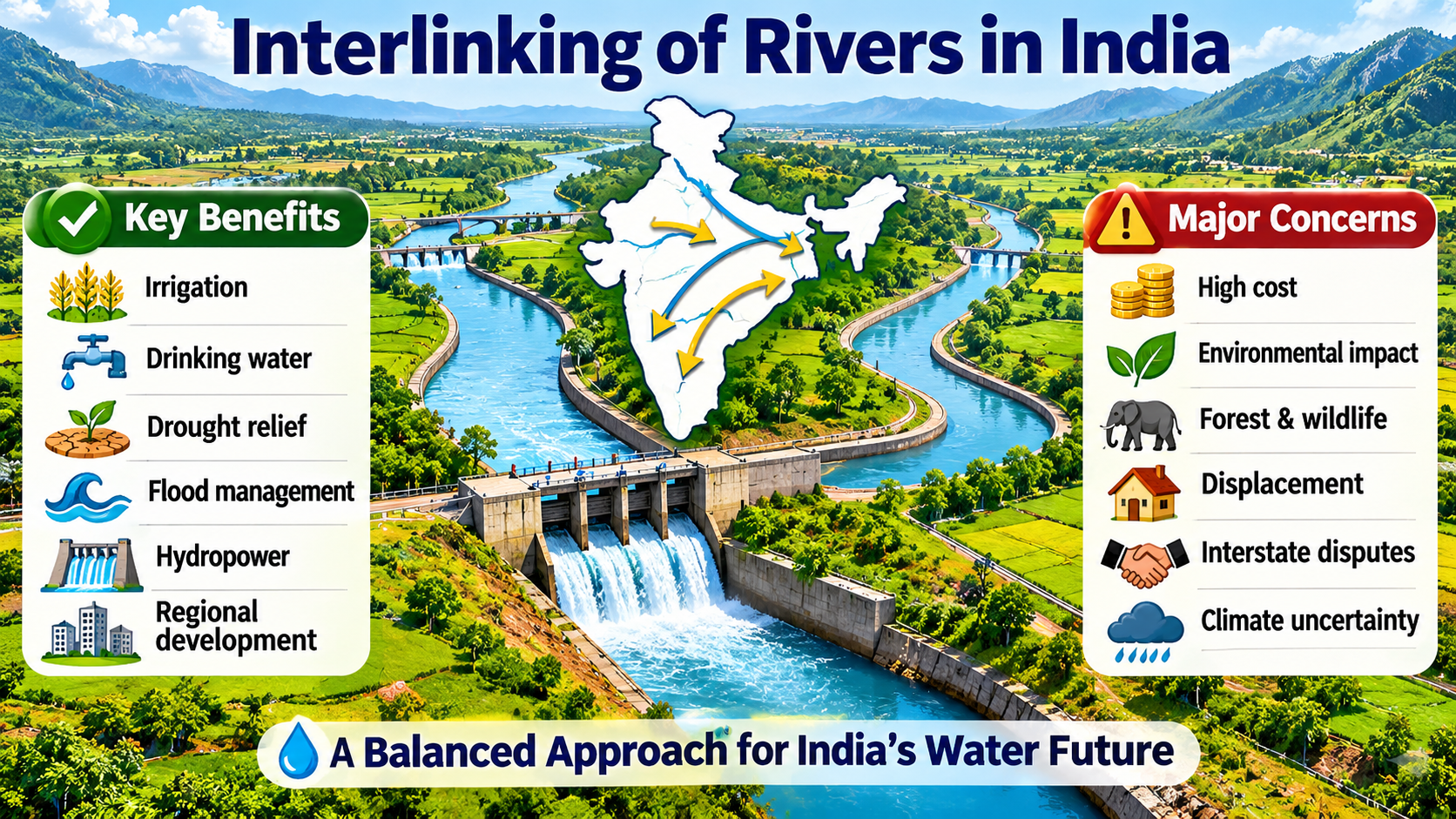
River interlinking has the potential to improve irrigation, drinking-water availability and drought resilience. However, it is also a complex undertaking involving enormous costs, environmental concerns, interstate water-sharing disputes and the displacement of communities.
Let us understand how river interlinking works, why it is proposed, the major projects in India and the issues that must be considered before implementation.
1. What Is Interlinking of Rivers?
Interlinking of rivers is a water-management strategy in which two or more river systems are connected through engineered infrastructure.
A river normally carries water through its natural drainage basin towards a lake, estuary or sea. Under a river-linking project, some of that water may be diverted through a canal, tunnel, reservoir or other structure into another river basin.
The objective is to make water available in areas where demand exceeds locally available supplies.
For example, a proposed link might transfer water from one basin during periods of suitable availability to another basin where additional water is required for agriculture or drinking-water supply.
However, a river should not automatically be labelled water-surplus simply because it carries a large volume of water during the monsoon. Planners must consider seasonal flows, existing users, ecological requirements, rainfall variability and future climate conditions.
The amount of water that can actually be transferred depends on detailed hydrological studies and agreements between the states concerned.
2. Why Is River Interlinking Proposed in India?
India has varied climatic conditions, landscapes and patterns of rainfall. Some river basins receive substantial monsoon flows, while other regions experience recurring water stress.
River interlinking has been proposed as one possible way of managing these differences.
The major objectives include:
- Improving irrigation in water-deficient agricultural areas
- Providing drinking water to towns and villages
- Reducing the effects of drought in selected regions
- Managing certain flood risks through planned storage and transfers
- Improving the reliability of water supplies
- Supporting agriculture and rural livelihoods
- Generating hydropower where project conditions permit
- Creating employment during construction and operation
These are intended benefits, not guaranteed outcomes. Every project must be assessed individually to determine how much water it can deliver, who will benefit and what costs or environmental impacts it may create.
3. History of India’s River-Interlinking Programme
The Government of India formulated the National Perspective Plan (NPP) in 1980 to study the transfer of water between river basins.
The National Water Development Agency (NWDA), established in 1982, was assigned a major role in investigating the feasibility of the proposed links.
The national programme has two broad components:
A. Himalayan Rivers Development Component
This component examines possible links involving the Ganga and Brahmaputra river systems and their tributaries.
Proposals include storage reservoirs and transfers intended to make water available in other regions. Some proposals also involve rivers that flow from or through neighbouring countries, which means international cooperation can be an important consideration.
B. Peninsular Rivers Development Component
This component examines possible links among rivers in central and southern India, as well as selected west-flowing river systems.
One of the best-known proposals is the transfer of water through parts of the Mahanadi–Godavari–Krishna–Cauvery river systems.
The overall National Perspective Plan identifies 30 links: 14 in the Himalayan component and 16 in the Peninsular component.
Official project information is available from the National Water Development Agency.
4. How Does a River-Linking Project Work?
A river-linking project may involve several major engineering structures.
Dams and reservoirs: These may store water when flows are available and release it according to the project’s operating plan.
Canals: Canals carry water between selected locations. Depending on the terrain, they may require pumping stations, tunnels, aqueducts or other structures.
Pumping stations: Where water must be moved to higher elevations, pumping can require substantial amounts of electricity.
Barrage structures: Barrages can regulate river flows and divert water into designated channels.
Distribution networks: Water transferred to another basin must still reach farms, villages, towns or reservoirs through an appropriate distribution system.
A link is therefore more than a canal between two rivers. It is a large water-management system that needs planning, construction, operation, maintenance and coordination among multiple authorities.
5. Major River-Interlinking Projects in India
Several proposed links have reached different stages of investigation, planning, approval or implementation. Their status must be distinguished carefully: a completed feasibility report does not mean that construction has begun.
Ken–Betwa Link Project
The Ken–Betwa Link Project is one of India’s most prominent river-interlinking initiatives. It proposes transferring water from the Ken basin to the Betwa basin, with the objective of supporting water supplies and irrigation in parts of Madhya Pradesh and Uttar Pradesh.
The project involves major infrastructure, including the proposed Daudhan Dam and a connecting canal.
Its stated objectives include improving irrigation, supplying drinking water and generating electricity. At the same time, the project has raised concerns about forest land, wildlife habitat and impacts on the Panna landscape.
These issues make environmental safeguards, water-sharing arrangements and rehabilitation planning particularly important.
The project received central government approval in December 2021. For the official background and stated benefits, see the Prime Minister of India’s announcement.
Godavari–Krishna Link
The Godavari–Krishna link is associated with proposals to transfer water from the Godavari basin into the Krishna basin.
A component of this transfer is associated with the Polavaram project in Andhra Pradesh.
Such transfers are intended to improve the availability of water for irrigation and other uses. Their operation must nevertheless be considered alongside the water requirements of the source basin, downstream users and the relevant interstate agreements.
Mahanadi–Godavari Link
The Mahanadi–Godavari link forms part of the broader Peninsular Rivers Development concept.
The proposal examines the possibility of transferring water between river basins and making it available to regions where additional supplies may be needed.
Its feasibility depends on detailed assessments of water availability, existing uses, engineering requirements, environmental effects and agreement among the states concerned.
Other Proposed Links
India’s National Perspective Plan also includes proposals involving rivers such as the Damanganga, Pinjal, Par, Tapi, Narmada, Krishna, Pennar and Cauvery.
These projects are at different stages and should not be treated as a single construction programme that is already complete or fully operational.
For the latest published project-status information, consult the Ministry of Jal Shakti’s river-interlinking updates.
6. What Are the Potential Benefits of River Interlinking?
Better irrigation
Agriculture depends on the availability of water at the right time. A well-designed water-transfer project may improve irrigation reliability in selected areas and reduce dependence on uncertain rainfall.
The actual benefit will depend on the volume of water delivered, the timing of transfers, the efficiency of distribution networks and the way farmers use the supply.
Drinking-water supply
Some projects are designed to provide water for towns and villages that experience shortages.
However, transferring water is only one part of the solution. Treatment plants, distribution pipelines, storage systems and reliable local infrastructure are also essential.
Drought resilience
A carefully planned transfer may provide additional supplies during periods of water stress.
It cannot eliminate drought everywhere, because drought depends on rainfall, temperatures, soil moisture, groundwater conditions and the demands placed on available water.
Hydropower generation
Some projects include dams or other structures that may support electricity generation.
The amount of power produced depends on the design, water availability and operating conditions. Pumping water uphill can also consume substantial electricity, which must be included in the project’s overall energy assessment.
Employment and regional development
Construction can create jobs in engineering, transport, construction and related industries. Better water availability may also support farming and other economic activities.
These benefits need to be weighed against the project’s total cost, maintenance requirements, displacement impacts and the possibility that some intended benefits may not materialise as expected.
7. Can River Interlinking Control Floods?
Flood management is often cited as a potential benefit of river interlinking.
In certain circumstances, reservoirs and carefully operated infrastructure can store some incoming water or change the timing of its release.
However, river linking is not a universal solution to floods.
Flooding depends on rainfall intensity, the condition of the river channel, reservoir capacity, soil saturation, land use, drainage infrastructure and other factors.
If a reservoir is already full, its ability to absorb additional floodwater may be limited. Water transfers may also be constrained by the receiving river’s capacity and the safety of downstream communities.
Effective flood management requires a combination of forecasting, floodplain protection, suitable reservoir operations, wetland conservation, drainage improvements and responsible land-use planning.
8. Environmental Concerns Associated with River Interlinking
Large water-transfer projects can change the way rivers and surrounding ecosystems function. Their environmental impacts must be assessed before decisions are made.
Changes to natural river flows
Rivers support fish, aquatic plants, wetlands, floodplains and communities downstream. Diverting water may change seasonal flows and the amount of water reaching downstream ecosystems.
Maintaining suitable environmental flows is therefore an important part of project planning.
Forest loss and wildlife impacts
Dams, reservoirs, canals and associated infrastructure may require land acquisition and can affect forests or wildlife habitats.
Where protected areas or sensitive ecosystems may be affected, planners must evaluate alternatives, assess cumulative impacts and provide enforceable safeguards.
Effects on wetlands and aquatic life
River systems transport sediment and nutrients and support breeding and feeding habitats. Changes in flow patterns may affect fish migration, aquatic organisms and wetland health.
The impact depends on the specific river, the engineering design and how the project is operated.
Displacement of communities
Reservoirs and other infrastructure can require people to move from affected areas. This may disrupt homes, farmland, livelihoods and cultural connections to the landscape.
Fair compensation, rehabilitation, consultation and livelihood restoration are essential considerations.
Energy use and greenhouse-gas emissions
Large pumping systems may require substantial electricity. Reservoirs can also have environmental effects that vary according to their location and characteristics.
Energy consumption and emissions should be assessed alongside the project’s expected water and economic benefits.
9. Will River Interlinking Solve India’s Water Crisis?
River interlinking may help address specific water shortages, but it cannot solve every water problem on its own.
India’s water challenges also involve groundwater depletion, pollution, inefficient irrigation, leaking distribution networks, urban growth, changing rainfall patterns and the loss of lakes and wetlands.
Several complementary measures are important:
- Rainwater harvesting
- Protection and restoration of lakes, tanks and wetlands
- Groundwater recharge and responsible extraction
- More efficient irrigation methods where appropriate
- Repair of leaking water-supply systems
- Treatment and reuse of wastewater
- Protection of watersheds and forests
- Better management of urban stormwater
- Water conservation by households, farms and industries
In many locations, improving existing infrastructure and reducing waste may deliver important benefits alongside, or before, large new transfer projects.
10. What Are the Main Challenges?
Interstate water-sharing disputes
Rivers cross state boundaries, and each state has its own water requirements. Agreement is needed on how much water can be transferred, when transfers may take place and how shortages should be managed.
High construction and maintenance costs
Dams, tunnels, canals and pumping stations require large investments. Costs can rise because of land acquisition, delays, changing material prices and engineering difficulties.
A sound evaluation should consider the entire life-cycle cost, including electricity, maintenance and rehabilitation.
Environmental approvals
Project assessments must examine effects on forests, wildlife, groundwater, river flows, communities and public health. Where significant impacts are identified, alternatives and mitigation measures should be evaluated.
International coordination
Some Himalayan river proposals involve water systems that cross national borders. These projects may require coordination and agreements with neighbouring countries.
Climate uncertainty
Historical records cannot guarantee future rainfall and river flows. Climate change may alter the timing, intensity and reliability of water availability.
Projects should therefore be tested under a range of possible future conditions rather than assuming that a basin will always have the same amount of surplus water.
11. What Does the Current Project Status Tell Us?
The National Perspective Plan is a long-term programme, not one single construction project.
According to a Ministry of Jal Shakti update published on 5 February 2026, feasibility reports had been completed for 26 of the 30 identified links, while detailed project reports had been completed for 13. The same update described the Ken–Betwa Link Project as the only priority link under the National Perspective Plan to have entered the implementation stage.
These figures refer to different stages of project preparation. They do not mean that all 26 feasibility-stage links or all 13 detailed-project-report links have been approved for construction.
Project status can change as technical assessments, funding decisions, environmental clearances and agreements between states progress.
Readers should check official government updates when discussing a particular link or its expected completion date.
12. What Should Be Considered Before Implementing a Project?
A responsible river-interlinking decision should answer several important questions.
- Is the source basin genuinely able to supply the proposed transfer after accounting for existing users and environmental needs?
- Will the receiving region obtain a reliable and useful water supply?
- Are less expensive alternatives available, such as local storage, conservation or improved irrigation?
- What will happen to forests, wildlife, wetlands and downstream communities?
- How will affected people be compensated and rehabilitated?
- Who will pay for construction, electricity, maintenance and future repairs?
- How will water be shared during droughts or unusually low-flow years?
- Can the project remain effective under changing climate conditions?
- Are the expected benefits supported by transparent studies and independent review?
- Are monitoring, public reporting and accountability arrangements in place?
Answering these questions can help distinguish projects that are likely to provide worthwhile benefits from those whose costs or risks may be too high.
Conclusion
Interlinking rivers is an ambitious approach to managing India’s uneven distribution of water. It may improve irrigation, drinking-water supply and drought resilience in some regions, and selected projects are progressing through planning and implementation.
However, river interlinking also involves major financial commitments, engineering challenges, environmental risks and difficult decisions about sharing a resource that communities and ecosystems depend on.
The best approach is not to assume that every river-linking project will succeed or that all such projects should be rejected. Each proposal should be evaluated using reliable hydrological data, transparent economic analysis, independent environmental assessment and meaningful consultation with affected communities.
River interlinking should form part of a wider water-management strategy that includes conservation, rainwater harvesting, groundwater protection, wastewater reuse and restoration of natural water bodies.
The ultimate goal should be reliable and equitable access to water while protecting rivers, ecosystems and the livelihoods of future generations.