



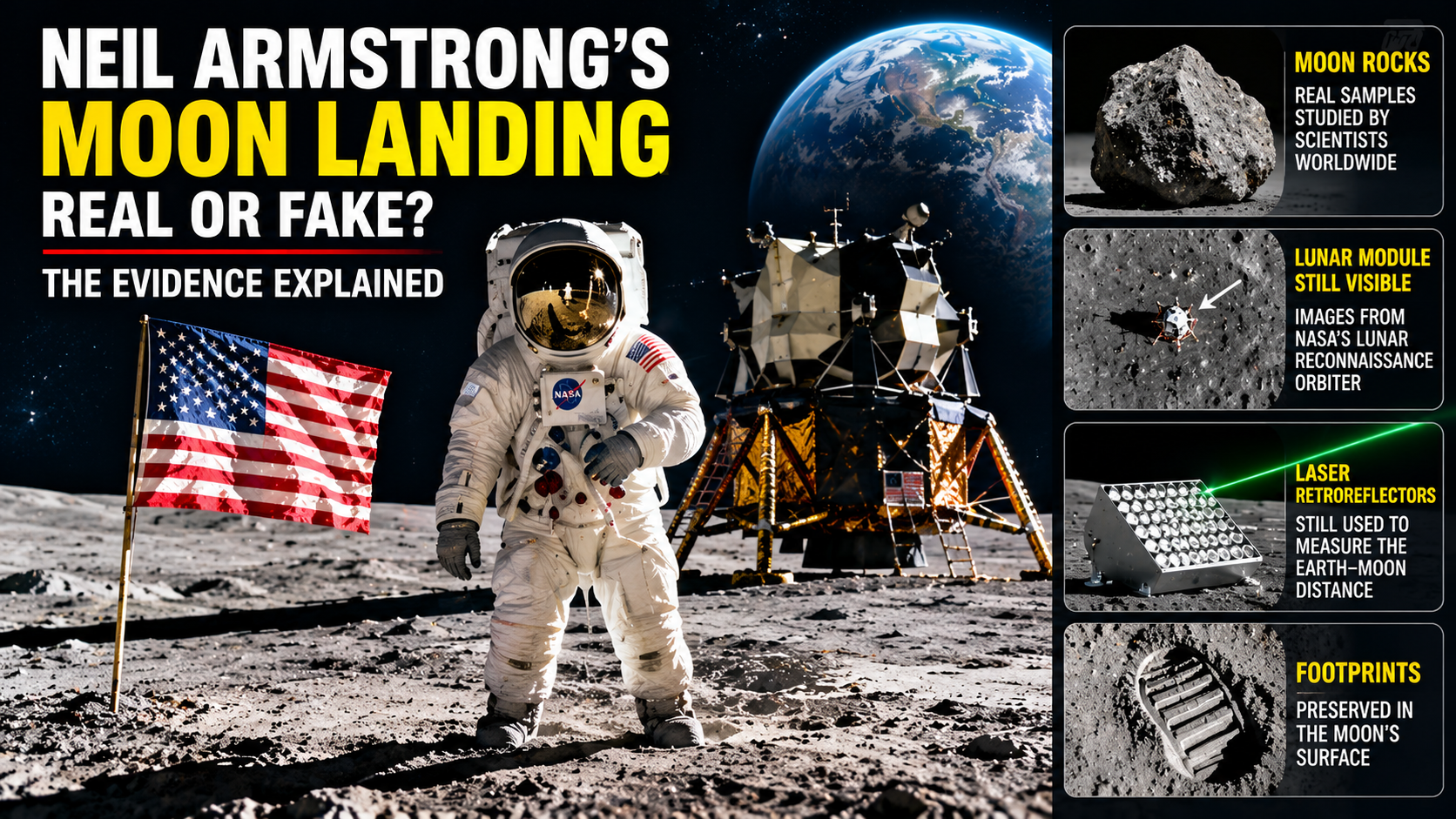
On July 20, 1969, astronaut Neil Armstrong became the first human to walk on the Moon during NASA’s Apollo 11 mission. His historic first step marked a major achievement in science, engineering and space exploration.
Armstrong was joined on the lunar surface by astronaut Buzz Aldrin, while Michael Collins remained in orbit around the Moon aboard the command module.
Although the Apollo 11 landing was documented through photographs, television broadcasts, scientific experiments and lunar samples, some people still question whether humans really reached the Moon.
Why does the American flag appear to move? Why are stars missing from many lunar photographs? And what evidence supports the claim that astronauts walked on the Moon?
Let’s examine the most common questions and the scientific evidence behind the historic mission.
What Happened During the Apollo 11 Mission?
Apollo 11 launched on July 16, 1969, carrying Neil Armstrong, Buzz Aldrin and Michael Collins. Four days later, Armstrong and Aldrin landed the lunar module Eagle in the Moon’s Sea of Tranquility.
Armstrong stepped onto the lunar surface first, followed by Aldrin. The astronauts collected rock and soil samples, photographed the surrounding landscape and deployed scientific instruments.
The astronauts returned to the lunar module and rejoined Collins in orbit. The crew then travelled back to Earth, splashing down in the Pacific Ocean on July 24, 1969.
The mission was not simply a televised event. It involved spacecraft navigation, communications, surface experiments, sample collection and the safe return of three astronauts.
NASA’s mission records document these activities in detail.
Source: NASA’s Apollo 11 Mission Overview.
Common Moon Landing Conspiracy Theories Explained
1. Why Does the American Flag Look Like It Is Waving?
One of the most frequently repeated claims is that the American flag appears to wave in Apollo photographs, even though the Moon has virtually no atmosphere and no wind like Earth’s.
The explanation lies in the flag’s design and how the astronauts handled it.
NASA equipped the flag with a horizontal support rod to help it remain extended. The fabric developed folds and wrinkles, making it appear wavy in photographs.
When the astronauts twisted and moved the flagpole while installing it, the fabric also moved. In the Moon’s vacuum, there was no air resistance to damp the movement in the same way it would on Earth.
The flag’s appearance is not evidence of wind or a film studio. Its support structure and the astronauts’ handling explain the effect.
2. Why Are There No Stars in the Moon Photographs?
Some Moon landing photographs show a bright lunar surface and astronauts against a dark sky, but no visible stars.
This is a camera-exposure issue.
The lunar surface and astronauts were illuminated by direct sunlight. Cameras were set to capture these bright subjects with suitable shutter speeds and exposure settings.
Stars are much fainter than the sunlit lunar landscape. With those camera settings, the stars were generally too dim to register in the photographs.
A similar effect occurs when taking pictures of brightly lit scenes on Earth: a photograph exposed for a sunlit subject may not show faint stars in the sky.
The absence of stars in the images does not mean the photographs were taken indoors.
3. How Could Footprints Remain Visible Without Moisture?
On Earth, footprints in sand may quickly disappear because of wind, rain and other environmental changes.
The Moon is different. Its surface is covered by a layer of loose material called lunar regolith, consisting of dust, tiny rock fragments and other particles.
These particles have been shaped by impacts and do not behave exactly like ordinary beach sand. The absence of wind and rain means footprints are not naturally erased by weather as they are on Earth.
When an astronaut’s boot pressed into the surface, the material retained the shape of the tread.
This explains why the footprints looked sharply defined in the photographs. Their appearance is consistent with the Moon’s surface conditions.
4. Why Didn’t the Soviet Union Expose the Landing as a Hoax?
The United States and the Soviet Union were intense competitors during the Cold War and the Space Race.
The Soviet Union had both the motivation and technical capabilities to scrutinize major American space achievements. Apollo missions also depended on radio communications that could be observed beyond NASA’s own facilities.
The fact that the Apollo missions were not exposed as a hoax by America’s leading space rival is relevant historical context. However, the strongest case does not depend on this argument alone. It rests on the combined evidence from mission records, lunar samples, scientific instruments and independent observations.
A claim of such a large-scale deception would need to explain how all those separate lines of evidence could be fabricated or misinterpreted.
Scientific Evidence That Humans Landed on the Moon
The Moon landing is supported by several different kinds of evidence. Their combined strength is much greater than any single photograph or video.
1. Photographs of the Apollo Landing Sites
NASA’s Lunar Reconnaissance Orbiter (LRO), launched in 2009, has photographed the locations of the Apollo missions from lunar orbit.
Images of the Apollo 11 landing site show the lunar module’s descent stage and traces associated with the astronauts’ movements and deployed equipment.
These orbital observations are consistent with the locations documented during the original mission.
The images are particularly valuable because they were collected by a spacecraft operating decades after Apollo 11.
View the images and explanation here: NASA — Apollo 11 Landing Site From Dawn to Dusk.
2. Moon Rocks Returned to Earth
Apollo astronauts brought lunar rocks and soil back to Earth for laboratory analysis.
Apollo 11 alone returned approximately 21.5 kilograms of lunar material. Across all six successful Apollo lunar landings, astronauts returned about 382 kilograms of samples.
Scientists have studied these samples to learn about the Moon’s composition, volcanic history and formation.
The rocks contain geological characteristics and histories that differ from those of ordinary terrestrial rocks. Researchers around the world have examined lunar material using progressively more advanced scientific methods.
These samples remain an important source of evidence for lunar science.
Source: NASA — Apollo 11 Returned Samples.
3. Laser Retroreflectors Left on the Moon
Apollo 11 astronauts placed a scientific instrument called a laser-ranging retroreflector on the lunar surface.
A retroreflector is designed to return incoming light towards its source. Scientists can send laser pulses towards the reflector and measure how long the light takes to travel to the Moon and back.
Using the travel time, researchers can calculate the Earth–Moon distance with great precision.
Apollo 11 was not the only mission to deploy such equipment: Apollo 14 and Apollo 15 also left lunar laser-ranging reflectors.
These instruments have contributed to decades of scientific measurements of the Moon’s orbit and motion.
Source: NASA — The Apollo Experiment That Keeps on Giving.
4. Independent Tracking and Radio Communications
Apollo missions required continuous communication and tracking during launch, the journey to the Moon, lunar orbit and the return to Earth.
Radio signals and mission activity could be observed by facilities beyond NASA. The Soviet Union also had space-tracking capabilities during the Space Race.
Independent tracking is an important part of the historical record because the missions were not documented solely through photographs produced after the event.
The tracking evidence complements the physical samples, mission telemetry and lunar experiments.
5. Scientific Experiments Conducted on the Moon
Apollo 11 astronauts deployed several scientific instruments on the lunar surface.
These included a passive seismic experiment to detect vibrations and a solar-wind experiment to collect particles emitted by the Sun.
The instruments provided scientific observations from the lunar environment. More advanced seismometers deployed during later Apollo missions returned data about lunar activity and the Moon’s internal structure.
The experiments are documented in NASA’s mission reports and scientific archives.
Source: NASA — Apollo 11 Preliminary Science Report.
6. The Scale of the Apollo Programme
The Apollo programme required contributions from a vast workforce of engineers, scientists, technicians, manufacturers, flight controllers and support personnel.
The programme involved complex launch vehicles, spacecraft, communications networks, navigation systems, mission simulations and recovery operations.
The scale of this effort is not, by itself, proof that a mission occurred exactly as described. However, the extensive technical records and the consistency between independent forms of evidence make the claim that the Moon landing was entirely fabricated extremely difficult to sustain.
Why Is the Moon Landing Still Questioned?
Conspiracy theories often persist when photographs or videos appear unfamiliar, especially when people interpret them without understanding the technology involved.
The Apollo missions took place in an environment unlike Earth. Lighting, shadows, surface dust, camera exposure and movement in low gravity can look unusual to someone seeing the images for the first time.
Another reason is that the original missions happened decades ago. Many people today encounter short clips or social-media posts rather than full mission records and scientific explanations.
Questioning historical claims is reasonable. The most useful approach, however, is to compare each claim with reliable evidence and consider whether the explanation fits all the available observations.
In Apollo 11’s case, the evidence comes from many sources: lunar samples, photographs, mission records, scientific instruments, orbital observations and tracking data.
Neil Armstrong’s Legacy
Neil Armstrong’s first step on the Moon became one of the defining moments of the twentieth century.
Apollo 11 demonstrated that humans could travel to another celestial body, conduct scientific work there and return safely. The mission also expanded scientific understanding of lunar geology and helped establish techniques for future exploration.
Its legacy extends beyond the United States. The data and samples collected through Apollo continue to contribute to research, while later robotic missions have improved our understanding of the Moon.
The mission remains a landmark in engineering, international scientific research and human exploration.
Conclusion: Was the Moon Landing Real or Fake?
The available scientific and historical evidence strongly supports the conclusion that Neil Armstrong and Buzz Aldrin walked on the Moon during Apollo 11 in July 1969.
The flag’s appearance can be explained by its support rod and movement. The missing stars in many photographs result from camera exposure. The preserved footprints are consistent with the lunar surface environment.
More importantly, the evidence goes far beyond photographs: lunar samples have been studied by scientists, retroreflectors have supported laser-ranging experiments, and orbital spacecraft have imaged the landing sites.
No single piece of evidence needs to carry the entire argument. Together, these independent lines of evidence provide a compelling and consistent record of the mission.
Apollo 11 was a real historical achievement, and its scientific legacy continues today.
What do you think is the most convincing piece of evidence for the Moon landing? Share your thoughts in the comments.