



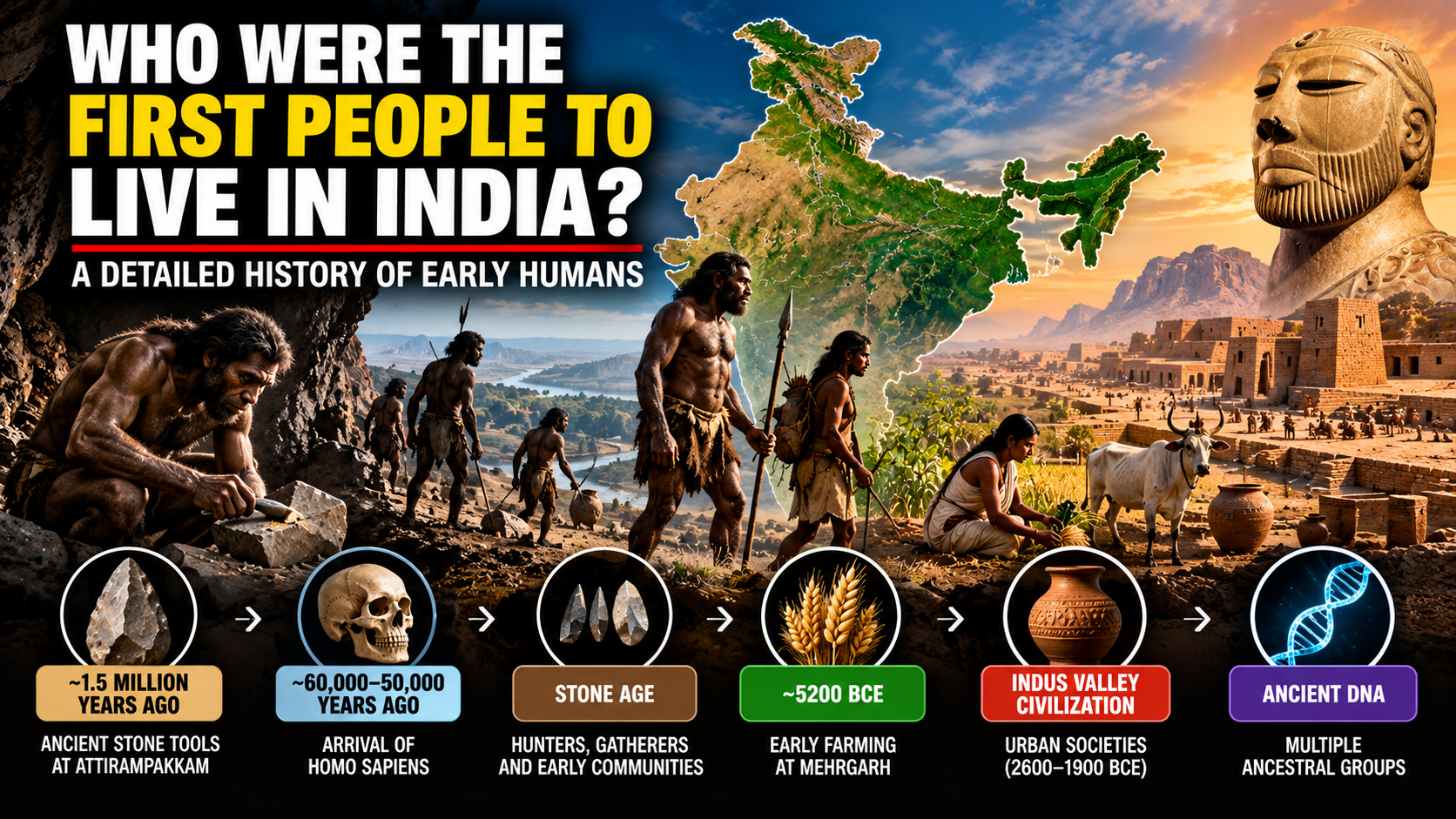
Who were the first people to live in India? Where did they come from, how did they survive, and how did their descendants contribute to the diverse population of the Indian subcontinent?
These questions connect archaeology, human evolution, genetics, and ancient history. Long before the rise of kingdoms, languages, religions, and cities, prehistoric people lived across the Indian subcontinent. They hunted animals, gathered wild plants, developed stone tools, adapted to changing climates, and eventually established farming communities and complex civilizations.
Scientific discoveries have revealed that India’s human history stretches back hundreds of thousands of years, while some of its oldest known stone-tool traditions are approximately 1.5 million years old.
However, an important distinction must be made: the earliest evidence of human activity is not necessarily evidence of the first modern humans, and neither tells us the exact identity of the first people who lived in India.
Let’s explore what archaeological discoveries and genetic research tell us about the earliest inhabitants of India.
1. How Far Back Does India’s Human History Go?
India’s prehistoric history began long before written records existed. Archaeologists reconstruct this period by studying stone tools, animal remains, sediments, ancient settlements, and other evidence preserved in the ground.
One of the most significant discoveries comes from Attirampakkam, an archaeological site in Tamil Nadu, near Chennai.
Researchers have found evidence of ancient stone-tool technologies at this location dating back approximately 1.5 million years. The discoveries demonstrate that early human relatives or populations were active in the region during the distant past.
These tools belong to the Acheulean technological tradition, which is associated with the manufacture of shaped stone implements, including hand axes and cleavers.
However, scientists have not established that the tools were made by Homo sapiens. Modern humans evolved much later than these archaeological remains.
It is therefore more accurate to say that India has evidence of ancient human activity dating back approximately 1.5 million years, but the species responsible for every early archaeological discovery is not known with certainty.
Source: Research on Acheulean archaeology at Attirampakkam.
2. Who Were the Earliest Humans in India?
The word “human” can refer to modern humans, Homo sapiens, or more broadly to earlier members of the human evolutionary lineage.
This distinction matters because different human species existed at different times.
Early human relatives
The oldest archaeological evidence from India includes stone tools made by ancient populations whose exact biological identities are not always known.
Early human groups probably depended heavily on their surroundings. They used available stones to make cutting tools and other implements, adapted to local environments, and obtained food from animals and wild plants.
Scientists continue to investigate which species produced different tool traditions and how these populations moved across Asia.
The arrival of Homo sapiens
Homo sapiens is the species to which all living humans belong.
Genetic and archaeological research indicates that modern humans originated in Africa and subsequently spread into other parts of the world, including South Asia.
A major scientific review published in 2013 discussed evidence supporting the dispersal of modern humans into southern Asia approximately 60,000–50,000 years ago. Other archaeological findings and interpretations continue to inform the debate about the timing and routes of these migrations.
The precise date of the earliest modern-human presence in the Indian subcontinent remains a subject of scientific investigation.
Importantly, the date of the earliest modern-human arrival should not be confused with the much older dates associated with prehistoric stone tools.
3. How Did Early People Reach the Indian Subcontinent?
Scientists generally agree that the ancestors of modern non-African populations ultimately came from Africa. However, the exact routes, timing, and number of migrations into South Asia remain subjects of research.
One widely discussed explanation involves movements through northeastern Africa and the Arabian Peninsula, followed by dispersal along coastal and inland routes into South Asia.
The Indian subcontinent occupies a significant geographical position between West Asia, Central Asia, and Southeast Asia. Its varied environments provided opportunities for different groups to settle and move over many thousands of years.
Early populations may have travelled through areas that are now part of Pakistan and northwestern India, as well as along routes connecting the Arabian Sea coast with southern India and beyond.
These migrations did not necessarily happen in one journey or at one moment. They involved movements over many generations, with groups adapting to different landscapes and sometimes encountering or mixing with other populations.
Archaeological evidence can reveal where people lived and how they made tools. Genetic evidence can help reconstruct relationships among populations. Neither type of evidence, by itself, provides a complete account of every migration.
4. How Did Prehistoric People Survive?
The earliest inhabitants of the subcontinent lived in environments very different from those of modern India.
Climate, vegetation, rivers, animal populations, and sea levels changed substantially over time. Human groups had to adapt to these conditions to survive.
Many prehistoric communities relied on hunting and gathering.
Their food sources could include:
- Wild fruits, roots, seeds, and edible leaves.
- Nuts and other seasonal plant foods.
- Fish and aquatic resources where available.
- Animals hunted individually or cooperatively.
- Small animals and other resources collected from the surrounding environment.
The precise diet depended on the location, climate, and period.
These communities did not have modern agriculture, supermarkets, or permanent food-distribution systems. Their survival depended on knowledge of local plants, animals, water sources, and seasonal changes.
Cooperation was also important. Sharing information, caring for children, and coordinating activities helped human groups survive in challenging environments.
It would be misleading, however, to assume that all early people lived in exactly the same way. Prehistoric societies differed across the vast geographical area of South Asia.
5. The Stone Age: A Major Period in India’s Prehistory
Archaeologists divide the Stone Age into broad periods based on changes in tools and ways of life. The boundaries differ by region, and the transitions were not identical everywhere.
Paleolithic Age: The Old Stone Age
The Paleolithic period is associated with early stone-tool technologies and economies based largely on hunting and gathering.
Some of India’s oldest known stone-tool traditions belong to this broad period.
At Attirampakkam, archaeologists have discovered evidence of Acheulean tools, including implements made by shaping stone to produce useful cutting edges.
Over time, different tool-making traditions developed. Some tools were large and carefully shaped, while others were smaller flakes designed for particular tasks.
These technologies demonstrate that prehistoric people possessed practical knowledge of stone, force, shape, and material selection.
Mesolithic Age: The Middle Stone Age
The Mesolithic period is generally associated with smaller stone tools, often called microliths, and a continued reliance on hunting, gathering, and other wild resources.
Microliths could be incorporated into composite tools, including implements with wooden shafts or handles.
Communities used different strategies depending on their environments. Some exploited forests, others river systems or coastal areas, and still others open grasslands.
The timing of the Mesolithic period varied across the Indian subcontinent. It should not be treated as a single uniform phase that began and ended everywhere simultaneously.
Neolithic Age: The New Stone Age
The Neolithic period is associated with the development and spread of farming, animal domestication, more settled communities, and new technologies.
Some communities began cultivating crops and keeping domesticated animals, while others continued hunting and gathering.
The transition to farming happened at different times in different regions. It was not a single event that suddenly changed the lives of everyone in India.
In some places, farming communities developed permanent settlements. They built houses, stored food, produced tools, and developed new social and economic relationships.
Source for the broader prehistoric timeline: India: The Ancient Past — archaeological and historical overview.
6. When Did Farming Begin in the Indian Subcontinent?
Farming was one of the most important developments in human history because it allowed some communities to produce food rather than depend entirely on wild resources.
Mehrgarh, located in present-day Balochistan, Pakistan, is one of the most important early farming sites in South Asia.
Archaeologists have discovered evidence of settlement, plant cultivation, animal management, and changing economic practices at the site.
Older accounts often dated the earliest occupation of Mehrgarh to around 7000–8000 BCE. However, research reported by Nature India in April 2025 described new radiocarbon evidence that revised the chronology of its earliest known farming settlement to approximately 5200 BCE.
This is an important reminder that archaeological dates can change when scientists obtain new samples or apply improved dating methods.
Mehrgarh was not located within the present borders of India, but it is essential to the history of the wider Indian subcontinent, which includes present-day India, Pakistan, and Bangladesh.
Farming developed differently in different regions. The history of agriculture in the Ganges plains, the Deccan, and southern India cannot be reduced to the story of a single settlement.
Source: Nature India — New research revises the chronology of farming at Mehrgarh.
7. How Did Ancient People Develop Settlements and Civilizations?
As communities developed different food-production systems and trading relationships, some settlements became larger and more complex.
People increasingly exchanged goods, developed specialised skills, and built social networks connecting distant regions.
In some areas, agricultural production supported larger populations and permanent settlements. Over time, these developments contributed to the rise of urban societies.
One of the most remarkable examples was the Indus Valley Civilization.
The Indus Valley Civilization
The Indus Valley Civilization, also called the Harappan Civilization, flourished across parts of present-day Pakistan and northwestern India.
Its mature urban phase is generally dated to approximately 2600–1900 BCE.
Important archaeological sites include:
- Harappa, in present-day Pakistan.
- Mohenjo-daro, in present-day Pakistan.
- Dholavira, in Gujarat, India.
- Rakhigarhi, in Haryana, India.
- Lothal, in Gujarat, India.
These settlements reveal sophisticated urban planning, drainage systems, craft production, trade, and standardised weights and measures.
Harappan communities produced pottery, ornaments, tools, and other goods. They also maintained connections with neighbouring regions.
Although the civilization left behind a large body of material evidence, its writing system has not been conclusively deciphered. As a result, many questions about its languages, political organisation, and religious practices remain unanswered.
The Indus Valley Civilization was not the beginning of human life in India. It emerged after a very long period of prehistoric occupation and cultural development.
8. What Does Ancient DNA Tell Us About the Ancestry of Indians?
Archaeology reveals the material remains of ancient societies, while genetics offers another way to study population history.
Ancient DNA research has significantly changed scientific understanding of the ancestry of people living in South Asia today.
A major study published in Science in 2019 analysed hundreds of ancient human genomes from South and Central Asia. The researchers found that modern South Asian populations formed through complex processes involving several ancestral populations and repeated episodes of mixing.
These included ancestry related to ancient South Asian hunter-gatherers, populations connected to ancient groups of the Iranian plateau, and Steppe pastoralist populations whose ancestry spread into parts of South Asia during the Bronze Age.
The terms used in genetic studies are technical descriptions of ancestral relationships. They do not necessarily mean that an individual’s ancestors came directly from a present-day country or belonged to a modern ethnic group.
For example, “Iranian-related ancestry” refers to genetic relationships with ancient populations associated with the Iranian plateau. It does not establish that all people carrying that ancestry migrated directly from modern Iran.
The study also found that people associated with the Indus Civilization or neighbouring communities contributed substantially to the ancestry of later South Asian populations.
What about AASI?
Researchers use the term Ancient Ancestral South Indians (AASI) for a deeply rooted South Asian hunter-gatherer-related ancestry component inferred from genetic comparisons.
AASI is a scientific reconstruction rather than the name of a directly sampled ancient population with a complete reference genome.
The genetic history of South Asia therefore cannot be explained as a simple division between two fixed groups. Present-day populations have different combinations of ancestral components shaped by migration, mixing, and later social practices.
Source: The Formation of Human Populations in South and Central Asia — Science.
9. Were the First Inhabitants of India One Single Ethnic Group?
No. The evidence does not support the idea that all the earliest inhabitants of India belonged to one identifiable modern ethnic, linguistic, or religious group.
The Indian subcontinent is geographically enormous and has been home to many populations over a very long period.
Ancient people lived in different environments, developed distinct technologies, and moved across regions at different times. Later populations mixed with earlier inhabitants, creating complex patterns of ancestry.
Modern identities such as Tamil, Telugu, Hindi-speaking, Bengali, Punjabi, or other linguistic and cultural identities developed through long histories of language change, migration, political organisation, and social interaction.
These modern identities should not be projected directly onto prehistoric populations.
Likewise, a genetic ancestry component does not establish a person’s language, religion, caste, or cultural identity.
Human ancestry is a history of branching, movement, and mixing—not a simple list of modern communities ranked from earliest to latest.
10. What Do We Know About the Ancient History of Tamil Nadu?
Tamil Nadu is particularly important to the archaeology of early South Asia.
The state contains evidence of prehistoric stone-tool production, ancient settlements, megalithic traditions, and early historic societies.
Attirampakkam
Attirampakkam is one of the most significant prehistoric archaeological sites in India.
Its stone-tool assemblages provide evidence of ancient human activity and changes in technology over long periods.
The site has helped researchers investigate the development of stone-tool traditions and the broader history of early populations in South Asia.
Prehistoric communities in southern India
Prehistoric people across southern India adapted to local landscapes, including river valleys, rocky uplands, forests, and coastal areas.
Their activities varied over time and could include hunting, gathering, tool-making, and eventually farming and animal management.
The spread of settled farming communities across southern India occurred over many centuries. It did not happen simultaneously across every region.
Megalithic traditions
Later prehistoric and early historic communities in southern India constructed megalithic monuments and burial structures.
These sites can contain pottery, iron objects, beads, and other artefacts. They provide evidence of social practices, craft traditions, and changing relationships between communities.
However, megalithic monuments do not, by themselves, establish a direct biological link to a particular modern language group.
The development of Tamil society
The emergence of early Tamil-speaking societies belongs to a much later period than the earliest stone-tool traditions.
The history of Tamil language, literature, trade, settlements, and political institutions must therefore be studied using evidence appropriate to each period, including inscriptions, archaeological remains, literary sources, and linguistic research.
Tamil Nadu’s prehistoric past is part of the wider history of South Asia, but its later cultural achievements should not be confused with the much earlier arrival of the first human populations.
11. Did the Vedic Civilization Begin When Humans First Arrived in India?
No. The Vedic period belongs to a much later stage of South Asian history.
The Vedas are ancient texts associated with early Vedic traditions. The period in which the earliest Vedic compositions developed is generally placed in the second millennium BCE, although the chronology and interpretation of particular texts remain subjects of scholarship.
By this time, the Indian subcontinent had already experienced hundreds of thousands of years of human activity, long traditions of stone-tool use, the development of farming communities, and the rise and transformation of the Indus Valley Civilization.
The Vedic period is therefore one chapter in a much longer history. It cannot be used as a date for the first human settlement of India.
It is also important to distinguish archaeological periods from textual traditions. Archaeological evidence, language history, and ancient texts provide different kinds of information and must be compared carefully.
12. How Scientists Reconstruct the First Inhabitants of India
No single discovery can explain the entire history of India’s earliest populations. Researchers combine several kinds of evidence.
Archaeology: Stone tools, pottery, settlement remains, and other artefacts reveal how people lived and how their technologies changed.
Dating methods: Techniques such as radiometric dating and luminescence dating help estimate the age of archaeological materials and the sediments in which they were found.
Palaeoenvironmental research: Ancient sediments, pollen, animal remains, and other evidence help scientists reconstruct past climates and landscapes.
Genetics: Modern and ancient DNA can reveal relationships among populations, migration patterns, and episodes of population mixing.
Linguistics: The study of languages can help reconstruct relationships between language families and investigate how languages spread or changed.
Each method has limitations. Stone tools do not automatically reveal the species that made them, genetic similarities do not establish cultural identity, and the spread of a language does not always require the complete replacement of one population by another.
The most reliable picture emerges when independent lines of evidence are evaluated together.
13. A Timeline of Early Human History in the Indian Subcontinent
The following timeline provides a simplified overview. Dates are approximate, and the archaeological record varies by region.
| Approximate period | Major development |
|---|---|
| Around 1.5 million years ago | Ancient stone-tool traditions documented at Attirampakkam in Tamil Nadu. |
| Around 60,000–50,000 years ago | A widely discussed timeframe for the dispersal of modern humans into South Asia. |
| Tens of thousands of years ago | Hunter-gatherer communities occupied diverse landscapes across the subcontinent. |
| Several thousand years ago | Farming and animal management developed and spread at different times in different regions. |
| Around 5200 BCE | Revised research places the earliest known farming settlement at Mehrgarh around this period. |
| Around 3300 BCE onward | Early Harappan communities developed across parts of northwestern South Asia. |
| Around 2600–1900 BCE | The mature urban phase of the Indus Valley Civilization. |
| Second millennium BCE | The period associated with the development of early Vedic traditions. |
This timeline is not a complete account of every region or population. It highlights some major developments supported by archaeological and scientific research.
Conclusion: India’s First Inhabitants Were Part of a Much Longer Human Story
The first people to inhabit the Indian subcontinent cannot be identified as one modern ethnic or linguistic group. The region’s human history developed over an enormous span of time through ancient migrations, changing technologies, adaptation to local environments, and repeated population mixing.
Archaeological sites such as Attirampakkam show that human relatives or populations were active in India around 1.5 million years ago. Modern humans arrived much later, with genetic and archaeological research placing a major phase of their dispersal into South Asia tens of thousands of years ago.
Over subsequent millennia, hunter-gatherer communities, farming societies, and urban civilizations emerged and interacted. The Indus Valley Civilization became one of the ancient world’s great urban traditions, while later periods saw the development of diverse languages, literary traditions, religious practices, and political institutions.
Modern genetic research adds another important insight: the ancestry of people in India reflects multiple ancient populations and extensive mixing over time.
The history is more complex than a story of one group replacing another, but that complexity makes it all the more fascinating.
India’s story did not begin with a kingdom, a language, or a civilization. It began with the long and still-unfolding story of human life on the subcontinent.