



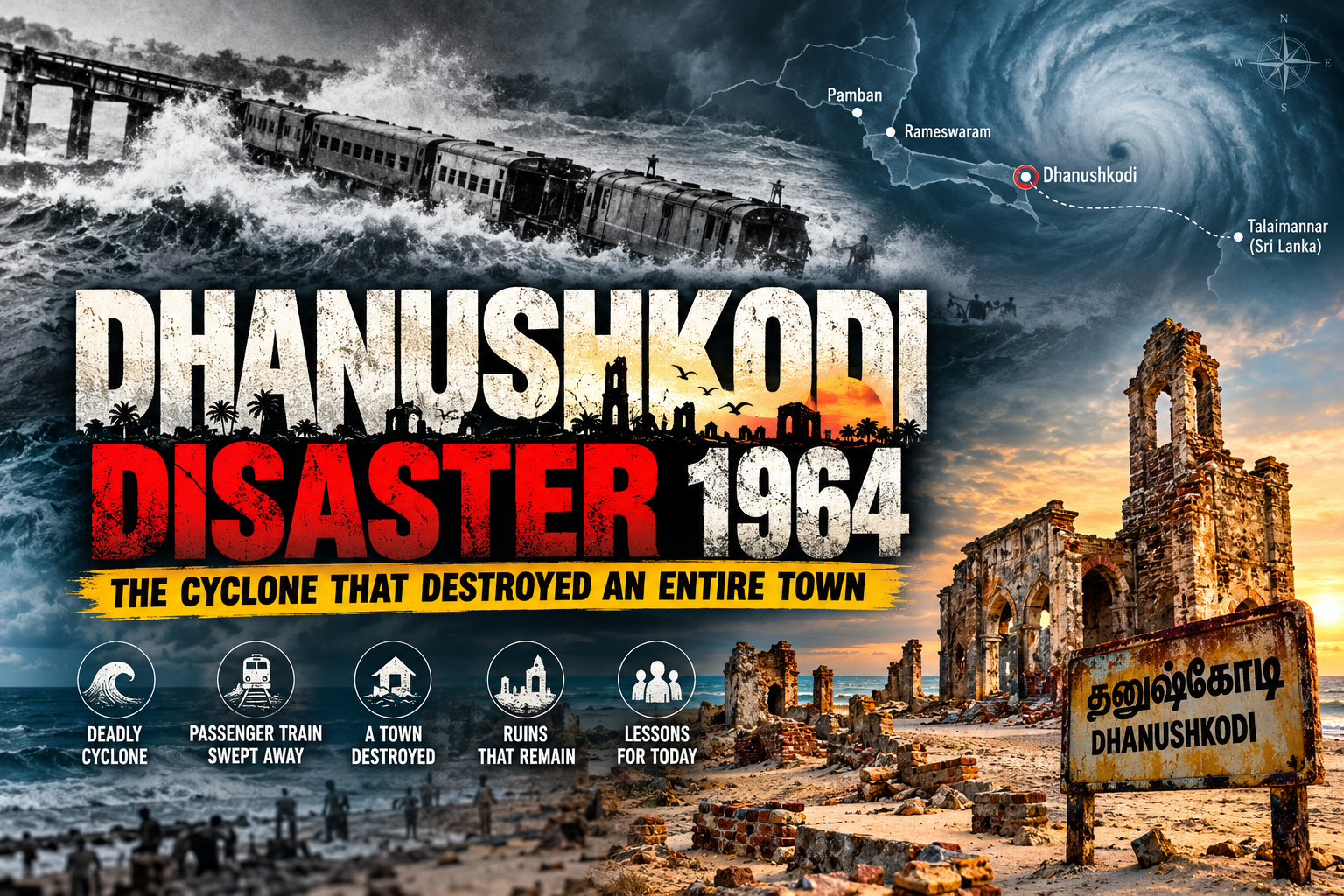
On the night of December 22–23, 1964, a devastating cyclone struck Dhanushkodi, a coastal town near Rameswaram in Tamil Nadu. Violent winds and powerful waves destroyed buildings, damaged railway infrastructure and claimed hundreds of lives. One of the most tragic events was the loss of passenger train No. 653, which was swept away by the storm.
Today, Dhanushkodi is known for its haunting ruins, beautiful coastline and tragic history. But before the disaster, it was a lively settlement and an important transport link between India and Sri Lanka.
Where Is Dhanushkodi?
Dhanushkodi lies at the southeastern tip of Pamban Island, near Rameswaram in Ramanathapuram district, Tamil Nadu. The area is surrounded by the waters of the Bay of Bengal and the Gulf of Mannar.
Before the 1964 cyclone, Dhanushkodi was a functioning town with homes, shops, public buildings, railway facilities and a ferry connection to Talaimannar in Sri Lanka. It served as an important transit point for travellers moving between the two countries.
According to historical accounts, the town also supported local trade, with goods transported through its port and ferry services.
Image suggestion: Insert a photograph of Dhanushkodi’s coastline or ruins here.
Suggested image caption: Dhanushkodi, Tamil Nadu, where the remains of the old settlement stand as reminders of the 1964 cyclone.
The Devastating Cyclone of December 1964
In December 1964, a powerful cyclone developed over the southern Bay of Bengal and intensified as it moved towards the region. The storm affected southern Tamil Nadu and Sri Lanka, bringing destructive winds, heavy rain and exceptionally high storm waves.
On December 22 and into the early hours of December 23, the cyclone devastated Dhanushkodi and surrounding areas. Seawater surged over low-lying land, sweeping away buildings and damaging transport links.
The India Meteorological Department’s historical research describes the Rameswaram cyclone as one of the most severe storms to affect the region. The storm generated destructive waves around Rameswaram and Mannar islands.
The impact was catastrophic for a town situated on a narrow, exposed stretch of land with little protection against the sea.
Image suggestion: Insert a historical cyclone photograph or a clearly labelled illustration of the 1964 storm.
Suggested image caption: An illustration of the extreme coastal conditions during the December 1964 Rameswaram cyclone. This is a reconstruction, not an authentic photograph of the disaster.
The Tragedy of Passenger Train No. 653
One of the most heartbreaking chapters in Dhanushkodi’s history was the destruction of passenger train No. 653, travelling from Pamban towards Dhanushkodi.
On the night of December 22, the train was caught in the severe storm near Dhanushkodi. Powerful waves swept the train away, killing those aboard.
Historical parliamentary proceedings reported that the train carried approximately 110 passengers and five railway employees. However, the total number of people who may have been aboard remains uncertain, as some accounts suggested that additional passengers were travelling.
The tragedy became one of the most memorable parts of the Dhanushkodi disaster. The railway accident was not an isolated event; it occurred amid a wider catastrophe that destroyed much of the town and its infrastructure.
The Government of India’s Commission on Railway Safety later published a report specifically documenting the wash-away of the Pamban–Dhanushkodi passenger train on December 23, 1964.
Image suggestion: Insert a historical photograph of the Pamban railway line or an illustration of a passenger train near the coast.
Suggested image caption: The Pamban–Dhanushkodi railway connection was destroyed during the 1964 cyclone. Use an authentic, properly credited historical image if available.
How Many People Died in the Dhanushkodi Disaster?
The exact death toll remains difficult to establish. Historical reports gave varying estimates, ranging from several hundred to around a thousand or more people.
The uncertainty reflects the scale of the destruction, the loss of records and the difficulty of accounting for everyone affected across the islands and coastal settlements.
The train disaster alone claimed the lives of those aboard, while many others died in the cyclone and storm waves that struck Dhanushkodi and surrounding areas.
For this reason, it is more accurate to describe the overall death toll as uncertain rather than present one number as definitively confirmed.
What Happened to the Town After the Cyclone?
The cyclone left Dhanushkodi severely damaged. Homes, religious buildings, railway facilities and other structures were destroyed, while the railway connection to the town was lost.
The town never returned to its former role as a busy settlement and international transit point. Its former railway and ferry connections with Sri Lanka were no longer able to operate as they had before the disaster.
The ruins that remain today provide a glimpse of the settlement that existed before the storm. Sections of old buildings and the remains of religious and railway structures have become landmarks associated with the tragedy.
The Ramanathapuram district administration records that Dhanushkodi was washed away by the 1964 cyclone, while the Kothandaramasamy Temple survived.
Why Is Dhanushkodi Called a Ghost Town?
Dhanushkodi is often called a “ghost town” because much of the old settlement lies in ruins and the town did not recover its former size and importance.
The name captures the striking contrast between the peaceful coastline and the remains of buildings destroyed by the cyclone.
However, Dhanushkodi is not completely devoid of human activity. People live and work in the wider area, and tourists visit the region to explore its coast, history and landmarks.
For many visitors, the ruins serve as a reminder of the families, workers and travellers whose lives were changed by the disaster.
Image suggestion: Insert a present-day photograph of the old church or railway-station ruins here.
Suggested image caption: The remains of old Dhanushkodi, a reminder of the town devastated by the 1964 cyclone.
Dhanushkodi Today: A Place of History and Natural Beauty
Today, Dhanushkodi is a popular destination for people visiting Rameswaram. Travellers come to see its long coastline, the surrounding waters and the remains of the old settlement.
The area offers remarkable scenery, but it is also a place of historical significance. Each surviving structure tells part of the story of a community that once lived and worked here.
Visitors should follow local instructions, respect restricted areas and avoid entering unstable ruins. Coastal weather and sea conditions can change quickly, so safety guidance should always take priority.
Lessons from the 1964 Dhanushkodi Disaster
The Dhanushkodi disaster remains a powerful reminder of the destructive potential of cyclones and storm surges, especially in low-lying coastal communities.
It highlights the importance of reliable weather warnings, timely evacuation, emergency communication and careful decisions about operating trains and other transport during extreme weather.
The tragedy also reminds us that disasters destroy more than buildings and infrastructure. They can erase communities, disrupt livelihoods and permanently change the history of a place.
More than six decades later, Dhanushkodi’s ruins preserve the memory of the people who lost their lives and the town that once connected India and Sri Lanka.
Conclusion
The 1964 Dhanushkodi cyclone was one of the most devastating natural disasters in Tamil Nadu’s history. The destruction of the town and the loss of passenger train No. 653 remain among its most tragic chapters.
Today, Dhanushkodi’s ruins stand between land and sea as a reminder of the storm’s immense power and the importance of disaster preparedness.
Behind every ruined building is a story of a place that once lived, worked and welcomed travellers. Remembering Dhanushkodi means remembering not only the disaster, but also the people and community that existed before it.
Sources and Further Reading
- India Meteorological Department (IMD): A Synoptic Study of the Rameswaram Cyclone of December 1964 and the Storm Wave Caused by It
- Government of India, Commission on Railway Safety: Report on the Wash-away of Passenger Train No. 653, Pamban–Dhanushkodi, on December 23, 1964
- Indian Parliament proceedings, March 9, 1965: Historical discussion of the Dhanushkodi cyclone and train disaster
- Ramanathapuram District Administration: Official information about Dhanushkodi
- Tamil Nadu Tourism: Dhanushkodi Beach
Editorial note: Historical accounts differ on the total death toll and the number of people aboard the train. Estimates are identified as such wherever appropriate. Ensure that photographs used in the published post are authentic, properly credited and licensed for reuse.