



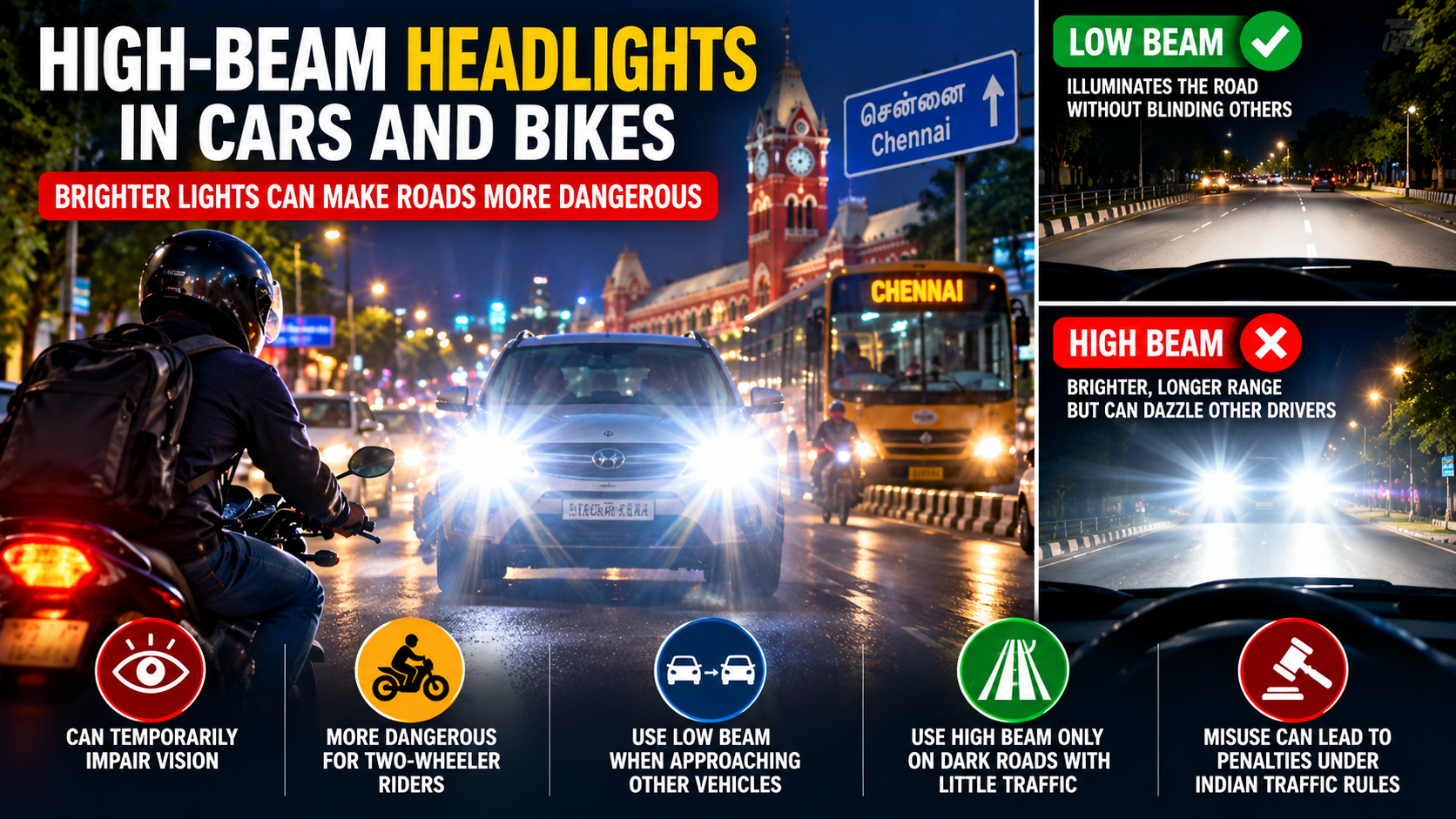
Extremely bright headlights may help one driver see farther, but when used incorrectly, they can make it difficult for everyone else to see the road.
Driving at night can be challenging, especially on poorly lit roads and highways. Drivers depend on their headlights to identify pedestrians, spot obstacles and react to unexpected situations.
However, a growing concern among road users is the misuse of high-beam headlights and the installation of excessively bright, improperly aimed or non-compliant aftermarket lights in cars and motorcycles.
In Chennai and other Indian cities, dazzling headlights can make night-time travel uncomfortable and potentially dangerous. Instead of improving safety for everyone, an incorrectly used high beam can temporarily impair the vision of oncoming drivers and two-wheeler riders.
So, when should high-beam headlights be used? Are modified headlights legal? And what can drivers do to make night-time roads safer?
Why Are High-Beam Headlights a Problem?
High-beam headlights produce a more concentrated, longer-reaching beam of light than low-beam headlights. They are useful in certain conditions, particularly on dark roads without street lighting.
The problem begins when drivers use high beams in situations where the light shines directly into another road user’s eyes.
This glare can make it harder to see the road, judge distances and identify hazards. After encountering an intense light source, a driver’s eyes may also need time to adjust to the darker surroundings.
The risks are particularly serious on roads where cars, motorcycles, bicycles and pedestrians share the same space.
1. Temporary Vision Impairment
When a vehicle approaches with excessively bright headlights, an oncoming driver may struggle to see lane markings, road edges or objects ahead.
The effect can be especially uncomfortable for older road users and people who already experience difficulty with night vision.
2. Increased Risk for Two-Wheeler Riders
Motorcycle and scooter riders have less physical protection than car occupants. If a rider is dazzled by an approaching vehicle, it may become harder to identify potholes, road debris or pedestrians.
A rider who reacts suddenly by braking or swerving may also put nearby road users at risk.
3. Danger on Highways
On highways, vehicles often travel at higher speeds, leaving less time to respond to hazards.
A driver blinded by an approaching high beam may briefly lose the ability to judge the road ahead accurately. Even a short period of reduced visibility can be dangerous at highway speeds.
4. Glare in Rear-View Mirrors
High beams can also affect drivers travelling in the same direction. When a vehicle follows too closely with its headlights on high beam, the light may reflect through the mirrors of the vehicle ahead.
This can distract the driver and make night-time driving more stressful.
Why Do Some Drivers Install Extra-Bright Headlights?
Some vehicle owners believe that brighter headlights automatically provide better visibility. Others install aftermarket LED bulbs, auxiliary lamps or modified headlamp assemblies to change the appearance or performance of their vehicles.
There is an important distinction between a properly designed lighting upgrade and a modification that creates excessive glare.
Headlight safety depends on several factors, including:
- Beam pattern: Light should illuminate the road rather than shine into the eyes of other drivers.
- Correct alignment: Headlights that point too high can dazzle oncoming traffic.
- Compatibility: A bulb should be suitable for the headlamp assembly in which it is installed.
- Brightness and intensity distribution: More light is not necessarily better if it is directed incorrectly.
- Vehicle condition: Damaged lenses, poorly fitted bulbs and incorrect adjustments can affect performance.
A powerful bulb installed in an incompatible headlamp housing may scatter light in unintended directions. This can create glare without providing a useful improvement in the driver’s view of the road.
Drivers should choose compliant equipment and have headlamps installed and adjusted by a qualified technician.
Is Using a High Beam an Offence in India?
India’s Motor Vehicles (Driving) Regulations, 2017 address the appropriate use of vehicle lighting.
Regulation 31 states that drivers must not use high beam inappropriately, for prolonged periods or on well-lit roads. It also requires drivers to dip their headlights in good time when approaching another vehicle or driving close behind one.
The regulations also require vehicle lighting devices to remain in good working condition and not be obscured by dirt or other objects.
You can read the regulation here: Motor Vehicles (Driving) Regulations, 2017 — Regulation 31.
Headlamp construction and alignment requirements are also relevant. Under Rule 106 of the Central Motor Vehicles Rules, vehicle headlamps must be constructed and fitted so that they do not dazzle other road users under the specified conditions.
This does not mean every aftermarket headlight is automatically illegal. The equipment, installation and use must comply with the applicable vehicle standards and regulations.
What about the fine? The ₹100 penalty mentioned in the original 2023 article should not be treated as a universal current fine. The applicable penalty depends on the provision enforced and the circumstances. Drivers should check current rules and official traffic-police guidance rather than relying on an old fine amount.
High Beam vs Low Beam: When Should You Use Each?
Knowing when to use each setting is one of the simplest ways to improve road safety.
Use Low Beam When:
- Driving in city streets with adequate street lighting.
- Approaching an oncoming vehicle.
- Following another vehicle at close range.
- Driving through busy residential or commercial areas.
- Passing pedestrians, cyclists or other vulnerable road users on undivided roads.
Use High Beam When:
- Travelling on a dark road with little or no street lighting.
- Traffic is sparse and there is no oncoming vehicle or vehicle ahead that could be dazzled.
- The road and weather conditions make additional forward illumination useful.
Always dip your headlights early when another vehicle approaches. Do not wait until the other driver flashes their lights at you.
High beam should not be used as a substitute for reducing speed or driving cautiously.
What Should You Do If an Oncoming Vehicle Uses High Beam?
Being dazzled by another vehicle can be frustrating, but retaliating by switching on your own high beam can make the situation worse.
Instead, follow these precautions:
- Avoid staring directly into the headlights. Keep your attention on the road ahead and use the left edge of your lane as a visual reference where appropriate.
- Reduce speed safely. Slow down if glare makes it difficult to see hazards or judge the road.
- Maintain your lane. Avoid sudden swerving or abrupt braking unless necessary to prevent a collision.
- Leave enough following distance. More space gives you additional time to react if the vehicle ahead slows down.
- Wait for your vision to recover. If visibility becomes seriously impaired, slow down further or stop at a safe location when possible.
- Never retaliate with high beams. Increasing the glare can endanger both drivers and other road users.
The priority is to get through the situation safely, not to prove a point to another driver.
What Can Chennai Drivers and Authorities Do?
Reducing headlight glare requires action from vehicle owners, workshops and enforcement agencies.
For Vehicle Owners
- Use compliant headlamps and bulbs suitable for your vehicle.
- Have headlight alignment checked during servicing.
- Avoid installing incompatible bulbs or poorly aimed auxiliary lights.
- Keep headlamp lenses clean and in good condition.
- Switch to low beam when approaching or following other vehicles.
For Vehicle Workshops
Workshops should ensure that lighting modifications meet applicable requirements. They should also explain that an improperly installed brighter bulb can reduce safety for other road users.
For Traffic Police and Authorities
Authorities can help by conducting targeted checks for dazzling or non-compliant vehicle lighting, investigating public complaints and educating motorists about correct headlight use.
Public-awareness campaigns should explain the difference between high beam and low beam, demonstrate the risks of glare and encourage responsible night-time driving.
Enforcement should focus on applicable rules and verified violations rather than assuming every bright headlight is unlawful.
Do Brighter Headlights Always Improve Visibility?
No. Headlight performance depends on more than brightness alone.
A well-designed headlamp directs light where the driver needs it while limiting glare for other road users. An excessively bright or poorly aligned lamp may illuminate parts of the surroundings while also making it harder for an oncoming driver to see.
Before upgrading your headlights, consider whether the existing lamps are correctly aligned, whether the lenses are cloudy or damaged, and whether the lighting equipment is suitable for the vehicle.
Safe lighting is about seeing clearly without blinding others.
Conclusion: Use Headlights Responsibly
High-beam headlights are useful when used in the right conditions. But their misuse can create dangerous glare for drivers, motorcycle riders, cyclists and pedestrians.
Every road user has a responsibility to use vehicle lighting appropriately. Dipping headlights for oncoming traffic, avoiding incompatible modifications and maintaining correct headlamp alignment are simple steps that can make night-time journeys safer.
Chennai’s roads are already challenging in many places because of traffic, uneven surfaces and limited lighting. Preventable glare should not add another hazard.
The message is simple: use high beam only when necessary, switch to low beam in time, and remember that road safety depends on everyone being able to see.
Have you experienced blinding headlights while driving at night? Share your experience and suggestions in the comments.