



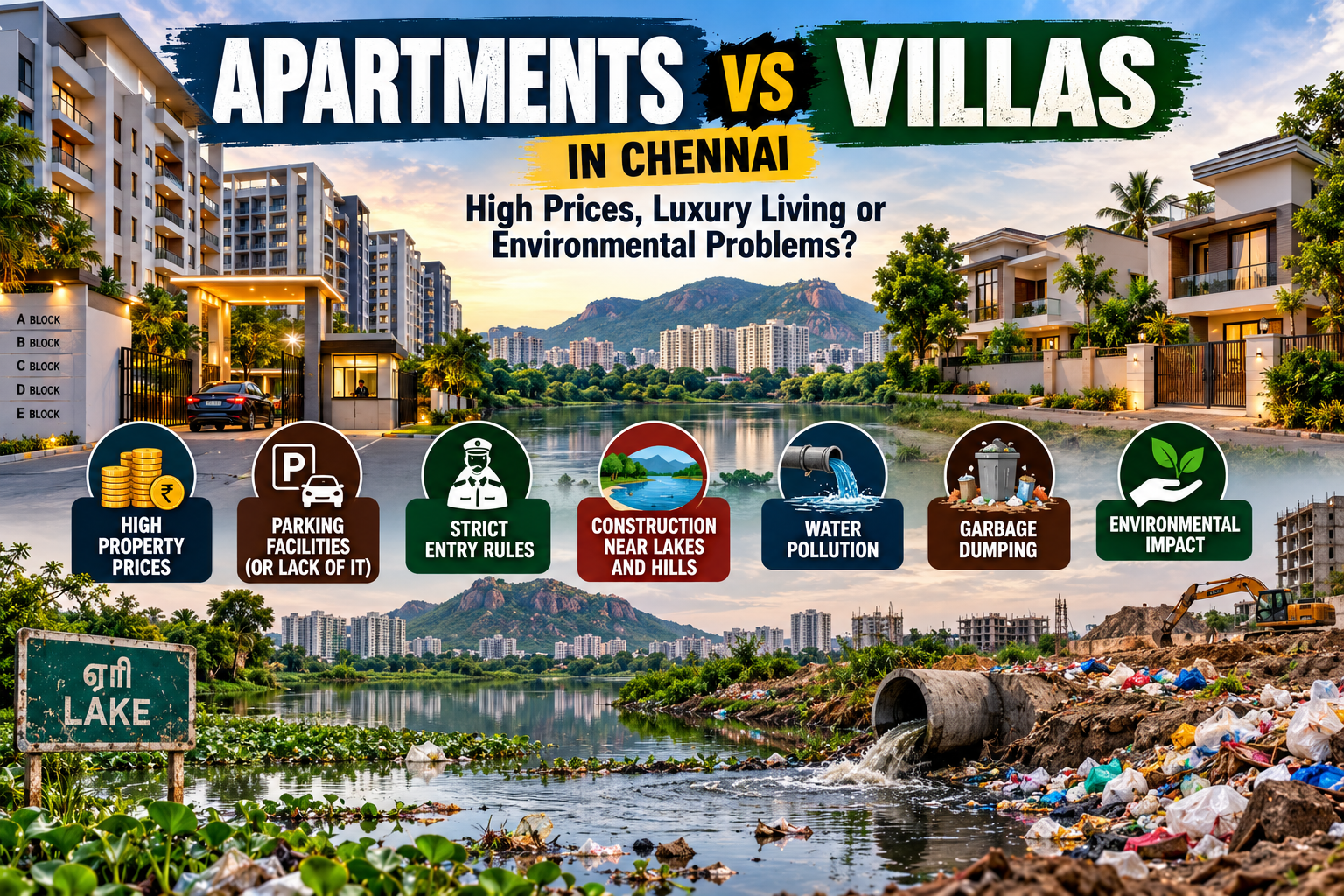
Introduction
Chennai and its surrounding areas have experienced significant residential development, with apartments, gated communities and villas becoming popular housing options. From premium high-rise buildings to independent houses on the outskirts, homebuyers have many choices depending on their budget and lifestyle.
For some buyers, owning an apartment worth several crores is a symbol of financial success and a comfortable lifestyle. Luxury projects may offer landscaped gardens, swimming pools, gyms, security systems and other modern facilities.
However, the growth of residential developments also raises important questions. Are buildings being constructed with adequate attention to the environment? Are lakes, wetlands and other water resources being protected? Is sufficient parking provided? Are sewage and garbage being disposed of properly? And are developers providing the facilities promised to buyers?
These questions deserve serious consideration before purchasing an apartment or villa in Chennai.
1. The Growth of Apartments and Villas in Chennai
Residential development can be seen in many parts of Chennai and its surrounding urban areas. Homebuyers encounter apartments, gated communities and villa projects at a wide range of prices.
Some premium developments are marketed towards high-income buyers, with individual flats priced at several crores of rupees. Other projects target middle-income families and first-time homebuyers.
The facilities and construction standards vary considerably from one development to another. Therefore, buyers should not assume that a more expensive apartment is automatically safer, better constructed or more environmentally responsible.
A property’s real value depends on several factors:
- Location and access to workplaces, schools and hospitals
- Construction quality and structural safety
- Legal approvals and ownership documents
- Water supply and sewage infrastructure
- Parking and access roads
- Maintenance costs and the quality of common facilities
- Flood risk and the condition of nearby water bodies
- Resale value and long-term demand
The number of new projects alone does not establish whether the market is meeting local housing needs or whether every development is properly planned. Those questions require reliable market data and project-specific assessments.
2. How Are Apartment Buildings Designed?
Apartment buildings come in many forms. Some have only a few floors, while others are much taller. Large residential communities may divide their buildings into blocks labelled A, B, C and so on, or use numbers and individual names.
Each block may contain multiple flats, shared corridors, staircases, lifts and common facilities.
Depending on the project, residents may have access to:
- Covered or open parking
- Security gates and visitor registration
- Lifts and backup power
- Children’s play areas
- Gymnasiums and swimming pools
- Shared gardens and walking paths
- Water storage tanks
- Sewage treatment plants
- Waste collection areas
Not every apartment complex provides all these facilities. In particular, buyers should confirm whether an individual parking space is included in the agreement and whether the parking arrangement is legally approved.
A project may look attractive in a brochure, but the actual site plan and sale agreement are more important than promotional images.
3. High Property Prices: Who Can Afford These Homes?
Premium apartments and villas can cost several crores of rupees. Buyers may be attracted by spacious interiors, landscaped surroundings, exclusive facilities and the reputation of a developer.
However, the purchase price is only one part of the financial commitment.
Owners may also need to pay:
- Registration and applicable stamp duty
- Monthly maintenance charges
- Property tax
- Electricity and water expenses
- Parking charges, where applicable
- Repairs and replacement costs
- Charges for maintaining lifts, generators, gardens and other common facilities
A buyer taking a large home loan should also consider interest payments and the possibility of changes in income.
For example, a luxury flat may appear affordable based on the initial down payment, but recurring maintenance expenses can place additional pressure on the household budget.
The most expensive property is not necessarily the best home for every family. Buyers should choose a property that meets their needs without creating an unsustainable financial burden.
4. Private Maintenance and Apartment Association Rules
Many residential communities have an owners’ association or another management arrangement responsible for maintaining common facilities.
Such organisations may collect maintenance fees, manage security, arrange repairs and establish rules for residents and visitors.
Common rules may cover:
- Visitor entry and identity verification
- Vehicle parking
- Use of swimming pools and gyms
- Noise levels and community events
- Moving furniture into or out of the building
- Waste segregation and collection
- Renovation work
- Use of shared spaces
Security procedures can be helpful, especially for families concerned about unauthorised entry. However, rules should be transparent, reasonable and consistent with applicable law.
Before purchasing a flat, buyers should request a copy of the community rules and understand how decisions are made, how maintenance fees are calculated and how disputes are handled.
They should also ask whether the building has an effective residents’ association and whether there are outstanding maintenance or infrastructure problems.
5. Construction Near Lakes, Hills and Other Natural Features
A pleasant natural setting can be an attractive selling point for a residential project. Developers may promote views of hills, green spaces, lakes or other landscape features.
But a location that looks beautiful in a brochure also needs to be assessed for environmental and safety risks.
A development near a lake or wetland may require careful examination of:
- Whether the site lies within a legally restricted water body or its protected area
- The site’s historical land use and drainage patterns
- Flooding during heavy rainfall
- Groundwater conditions
- Access roads and emergency evacuation routes
- Sewage treatment and wastewater disposal
- Compliance with applicable planning and environmental approvals
Not every property near a lake or hill is illegal or unsafe. The key question is whether the particular development has the required approvals and whether its construction and operation protect the surrounding environment.
Buyers should not rely solely on statements such as “lake view,” “green surroundings” or “peaceful natural location.” They should check the property’s survey details, approved plans, flood history and relevant official records.
6. The Environmental Impact of Residential Construction
Large residential projects increase the number of people living in a particular area. This creates additional demand for drinking water, electricity, roads, drainage, sewage treatment and waste collection.
If these services are not planned and maintained adequately, the effects can extend beyond the project boundary.
Potential problems include:
- Increased pressure on local water supplies
- Overloaded drainage systems
- Sewage entering stormwater drains
- Construction dust and noise
- Loss of vegetation and open space
- Increased traffic
- Poorly managed construction debris
- Additional pressure on nearby lakes and wetlands
These risks are not limited to apartments. Independent houses, commercial buildings and other developments can also contribute to environmental problems when planning or waste management is inadequate.
Responsible development requires infrastructure to keep pace with the population it serves.
7. Water Pollution: Why Sewage Management Matters
Water pollution is one of the most serious environmental concerns associated with poorly managed urban development.
Residential buildings generate wastewater from bathrooms, kitchens, washing machines and other household activities. This wastewater must be collected, treated and disposed of through an appropriate system.
Depending on the size and approvals of a project, this may involve a sewage treatment plant, a connection to the public sewerage network or another authorised arrangement.
Problems can occur when sewage is discharged without proper treatment, treatment systems are not maintained, or waste is transported and dumped illegally.
The Tamil Nadu Pollution Control Board has previously reported inspections involving private sewage tankers illegally disposing of untreated sewage into water bodies and vacant land around Chennai. The Board warned that unlawful disposal would invite action. Read the report on sewage dumping in Chennai.
This demonstrates why proper wastewater management is essential. However, it does not prove that every apartment or villa near a water body is responsible for pollution.
What happens when sewage enters a lake?
Untreated sewage can introduce organic waste, nutrients and disease-causing microorganisms into water.
Possible consequences include:
- Deterioration in water quality
- Unpleasant odours
- Excessive growth of algae and aquatic plants
- Reduced oxygen levels that can harm aquatic life
- Increased health risks when contaminated water is used
- Damage to ecosystems and recreational spaces
The extent of the damage depends on the volume and composition of the wastewater, the condition of the water body and other environmental factors.
Why are lakes important to Chennai?
Lakes, wetlands and other water bodies can help store rainwater, support biodiversity and contribute to groundwater recharge. They may also help reduce flooding when their natural storage capacity and drainage connections are preserved.
The Nature Conservancy has documented environmental pressures affecting Sembakkam Lake, including wastewater inflows, solid waste, silt accumulation and encroachment. Read about restoration efforts at Sembakkam Lake.
Protecting lakes is therefore not just about preserving a scenic view. It is also about protecting water resources, local ecosystems and the resilience of surrounding neighbourhoods.
8. Garbage Dumping Outside Residential Communities
Clean surroundings are an important part of a healthy living environment. Residential associations should maintain common areas, provide suitable waste collection arrangements and ensure that waste is handed over through authorised systems.
Problems arise when residents, contractors or waste collectors leave garbage on roadsides, vacant plots, footpaths or near water bodies.
Such practices can cause:
- Bad smells and unsightly surroundings
- Blocked stormwater drains
- Increased flies, rodents and other pests
- Plastic waste entering waterways
- Soil and water contamination
- Additional cleaning costs for local authorities
A compound wall may keep a residential community clean on the inside, but waste management should not end at the gate.
A clean apartment complex should not come at the expense of a dirty public street.
At the same time, garbage found outside a residential development does not, by itself, establish who dumped it. Responsibility should be determined from evidence, such as collection records, observations, photographs and official inspections.
What should responsible residents and associations do?
- Segregate wet waste, recyclable materials and other waste.
- Arrange regular collection through authorised local services.
- Compost suitable organic waste where a safe, properly managed system is available.
- Ensure construction debris is removed through authorised channels.
- Prevent waste from entering drains, lakes and vacant land.
- Report repeated illegal dumping to the relevant local authority.
These practices help protect the entire neighbourhood rather than only the property boundary.
9. Do All Apartments Have Adequate Parking?
Parking is an important issue in apartment living, particularly in densely populated urban areas.
Some projects provide dedicated parking for residents, while others may have limited spaces or arrangements that do not meet a family’s needs.
Insufficient parking can result in vehicles occupying narrow roads, blocking footpaths or restricting access for emergency services.
Before buying a flat, check:
- Whether parking is included in the sale agreement
- Whether the designated space is clearly identified
- Whether the parking layout is shown in the approved plan
- Whether visitor parking is available
- Whether the entrance and internal driveways allow safe vehicle movement
- Whether parking arrangements are likely to change as more flats become occupied
Do not assume that a parking space shown in an advertisement is automatically included in the purchase price.
10. Apartments vs Villas: Which Is Better?
Apartments and villas offer different advantages, and neither is automatically the better choice.
Advantages of apartments
- A wide range of sizes and price points
- Shared facilities in many residential complexes
- Security and visitor management arrangements
- Shared responsibility for common infrastructure
- Potential convenience for people who prefer compact living
Disadvantages of apartments
- Recurring maintenance expenses
- Dependence on shared facilities and management
- Less private outdoor space in many units
- Possible parking limitations
- Rules governing common areas and renovations
- Potential disputes among residents
Advantages of villas
- Greater privacy in many designs
- More individual outdoor space
- More flexibility in the use of the property, subject to applicable rules
- Potentially easier access to a private garden or terrace
- Fewer shared walls in an independent house
Disadvantages of villas
- Higher land and purchase costs in many locations
- Greater responsibility for individual repairs and security
- Potentially higher landscaping and maintenance expenses
- Dependence on the quality of roads, drainage and other community infrastructure
- Possible restrictions in gated villa developments
A villa in a poorly serviced location can be less convenient than an apartment in a well-planned neighbourhood. Similarly, a premium apartment can be a poor investment if its construction quality, documentation or maintenance arrangements are unsatisfactory.
The right decision depends on the individual property, not simply its category.
11. What Should Homebuyers Check Before Purchasing?
Before paying an advance or signing a sale agreement, buyers should conduct independent checks.
Legal documents and approvals
Verify the title and ownership records, applicable planning and building approvals, and the project’s registration with the Tamil Nadu Real Estate Regulatory Authority (TNRERA), where required.
Check whether the completed building has the required completion or occupancy documentation, as applicable. Do not assume that a developer’s brochure is proof of approval.
Water supply and sewage
Ask where the drinking water comes from and whether the supply is reliable. Inspect the sewage treatment arrangements, maintenance records and authorised disposal method.
Flooding and drainage
Visit the location during or after heavy rainfall if possible. Ask neighbouring residents about flooding, stagnant water, road access and previous drainage problems.
Construction quality
Seek an independent assessment where appropriate. Check for visible cracks, seepage, poor finishing, ventilation problems and the quality of shared facilities.
Maintenance charges
Request a breakdown of monthly charges and ask how major repairs, lift replacements, water shortages and treatment-plant maintenance are funded.
Surrounding neighbourhood
Inspect nearby streets, public transport, schools, hospitals, shops, waste collection arrangements and access roads. A property’s surroundings matter just as much as its interiors.
12. How Can Residents Report Environmental Problems?
If residents witness sewage discharge or illegal garbage dumping, they should record the details carefully and report the matter through the appropriate official channel.
Useful evidence may include:
- Date and time of the incident
- Location and nearby landmarks
- Photographs or videos taken safely and lawfully
- Description of the suspected discharge or dumping
- Information about the affected drain, lake or public road
For suspected environmental pollution, the Tamil Nadu Pollution Control Board provides an online complaint facility:
TNPCB Online Pollution Complaint Portal: https://tnpcb.gov.in/olgprs/
The complaint should identify the location and describe the observed problem as clearly as possible. The Board can assess complaints that fall within its jurisdiction. Other matters may need to be reported to the relevant municipal corporation, municipality, town panchayat or other local authority.
Residents should avoid making unsupported accusations against specific developers or communities. Documented evidence and official inspections provide a stronger basis for action.
13. What Should Developers and Local Authorities Do?
Sustainable residential development requires cooperation among developers, apartment associations, residents and public authorities.
Developers should provide accurate information about approvals, water supply, sewage treatment, parking and promised amenities. They should also ensure that required infrastructure is installed and maintained in accordance with applicable conditions.
Apartment associations should manage waste responsibly, maintain treatment facilities and prevent wastewater from escaping into public drains or water bodies.
Residents should follow waste segregation rules, pay applicable maintenance charges and report problems through proper channels.
Local authorities and regulators should enforce planning requirements, monitor pollution complaints and protect water bodies and drainage systems.
Development should not be judged solely by the number of flats constructed or the selling price of each unit. The quality of life created for both residents and neighbouring communities matters too.
Conclusion
Apartments and villas can provide comfortable homes for families in Chennai and its surrounding areas. Premium housing can offer modern amenities, while smaller and more affordable developments can meet the needs of a wider range of buyers.
However, property prices and attractive surroundings should not distract buyers from the fundamentals: legal approvals, construction quality, adequate parking, reliable water supply, effective sewage treatment and responsible waste management.
Lakes, wetlands, roads and public spaces are shared resources. Their protection is a responsibility that extends beyond the boundary walls of any individual property.
Before purchasing a home, examine the documents, visit the location, speak with existing residents and investigate the property’s environmental risks.
A good home is not simply a beautiful building. It should also be safe, legally compliant, financially manageable and part of a healthy neighbourhood.