



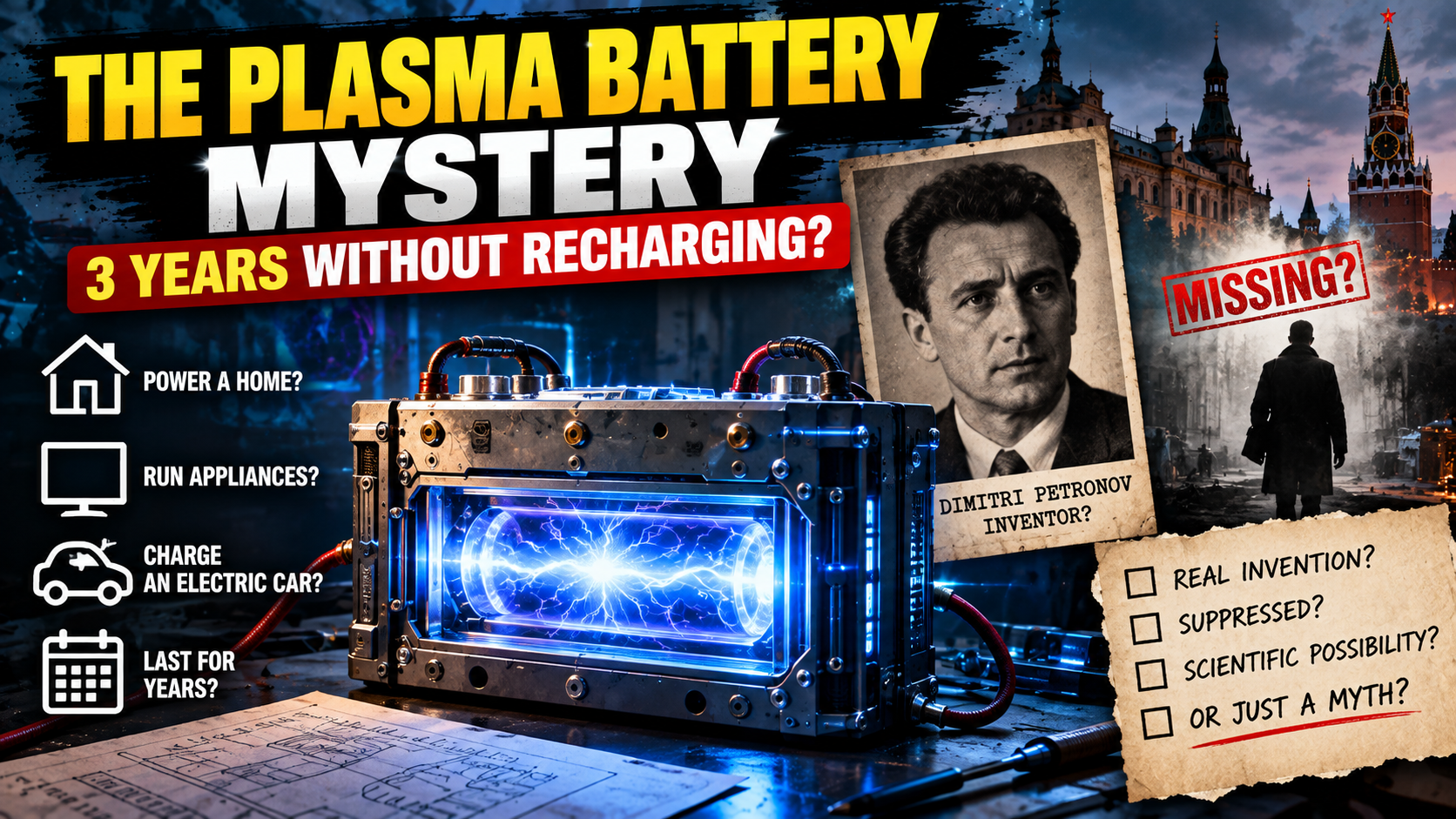
Imagine a battery that could power your home, television, washing machine, and lights for years without needing to be recharged. Imagine an electric car that could travel for a long time without stopping at a charging station.
It sounds like something from a science-fiction movie. Yet stories about a mysterious “plasma battery” have circulated online for years, raising questions about unusual inventions, missing inventors, and technologies that supposedly never reached the public.
But what is the real story behind this claimed invention? Could a battery really operate for three years without recharging? And is there reliable evidence that the technology was suppressed?
Let’s examine the claims and the science behind them.
1. What Is the Plasma Battery Story?
Online accounts describe a supposed Russian inventor named Dimitri Petronov who allegedly developed a compact battery capable of supplying electricity for years without being recharged.
According to the story, the inventor built a box approximately 35 centimetres in size. It supposedly powered several household appliances, including lights, a television, and a washing machine.
The same account claims that Petronov was invited to demonstrate an improved version of his invention at a military laboratory in Moscow in 2010. It then alleges that he disappeared and was never seen again.
The story has also been associated online with other names, including Aries M. DeGeus and Eugene Mallove.
However, these accounts should be treated cautiously. The story relies on online posts rather than independently verified technical documentation, reliable reporting, or published test results. The disappearance and suppression claims have not been established by credible evidence.
An intriguing story is not the same as a verified scientific discovery.
2. What Exactly Is Plasma?
To understand the claim, we first need to understand plasma.
Matter is commonly described as existing in three states: solid, liquid, and gas. Plasma is often called the fourth state of matter.
Plasma forms when a gas becomes ionised, producing charged particles such as free electrons and positive ions. It can conduct electricity and respond to electric and magnetic fields.
Examples of plasma include:
- The Sun and other stars
- Lightning
- The glowing gas inside certain fluorescent lamps
- The ionised gas used in some industrial processes
Plasma is important in modern science and technology. Researchers investigate its use in manufacturing, materials processing, chemical reactions, and energy-related applications.
But there is an important distinction: plasma is a state of matter, not automatically a source of free energy. Creating and maintaining plasma generally requires an energy input, and any practical device must account for where its electricity comes from.
3. Could a Battery Really Last Three Years Without Recharging?
A battery that operates for years without being plugged in is not physically impossible in every circumstance. The key question is how much power it supplies and where that energy comes from.
A small electronic sensor may consume so little electricity that a specialised battery can power it for many years. A washing machine, air conditioner, or electric car requires vastly more energy.
Consider the difference:
- Low-power devices: Sensors and certain remote monitoring systems may operate for years with carefully designed power supplies.
- Household appliances: A television, refrigerator, or washing machine can consume substantial energy, depending on usage.
- Electric vehicles: Driving requires significant energy, so a practical battery must store enough energy for the vehicle’s intended range and be recharged or supplied by another energy source.
A claim that one small box powered several household appliances for an entire year would therefore require detailed measurements. Investigators would need to know the electrical output, total energy delivered, operating conditions, and whether the device received energy from any external source.
Without those measurements, the three-year claim remains unverified.
4. Are There Batteries That Do Not Need Conventional Recharging?
Yes. Scientists have developed and studied several technologies that work differently from ordinary rechargeable batteries.
One example is the betavoltaic battery, which converts energy from radioactive decay into electricity. Some designs are intended to provide very small amounts of power over long periods.
These devices are fundamentally different from the alleged plasma battery. Their long operating life does not mean they can deliver unlimited electricity. Their output is generally suited to specialised, low-power applications rather than energy-hungry household appliances or electric vehicles.
Researchers are also working on improving lithium-ion batteries, sodium-ion batteries, solid-state batteries, and other energy-storage technologies. These developments aim to improve energy capacity, safety, lifespan, charging speed, or cost.
Plasma technology has a legitimate role in battery research too. Scientists study plasma-based techniques for preparing or modifying battery materials. That does not establish the existence of a plasma-powered battery capable of supplying a home for years without an external energy source.
5. Did Powerful Companies Suppress the Invention?
One of the most dramatic parts of the original story is the suggestion that large companies or governments prevented the battery from reaching the public because it would threaten the conventional battery industry.
It is reasonable to ask whether commercial interests can influence which technologies receive funding, investment, or market access. New inventions can face financial, regulatory, manufacturing, and competitive obstacles.
However, the specific claim that companies deliberately suppressed this alleged plasma battery requires evidence.
To establish such a claim, investigators would need credible documentation showing that the device worked, that relevant organisations knew about it, and that deliberate actions were taken to prevent its development or release.
The story alone does not establish those facts. A reported disappearance is also not proof that a person was murdered or that an invention was silenced.
Extraordinary claims need strong evidence, especially when they involve alleged crimes or secret technological breakthroughs.
6. What Evidence Would Prove That the Plasma Battery Works?
A genuine breakthrough would need to stand up to independent testing.
Researchers would want to examine several things:
Energy input: Does the device receive electricity, fuel, heat, radiation, or another source of energy?
Power output: How much electrical power can it supply continuously?
Total energy delivered: Can it operate for the claimed period while powering a clearly defined load?
Independent testing: Can laboratories reproduce the results without relying solely on the inventor’s statements?
Technical documentation: Are there detailed designs, measurements, safety evaluations, and credible scientific reports?
Practical performance: Can the device be manufactured safely and economically at a useful scale?
These questions matter because a battery’s operating time depends on its stored energy and the rate at which that energy is used. A device that powers a tiny sensor for three years is very different from one that runs an entire home for the same period.
7. What Would a Genuine Long-Life Battery Mean for the World?
If researchers developed a safe, affordable battery that could store much more energy and operate for longer periods, the benefits could be enormous.
Potential applications include:
- Longer-lasting power for remote sensors and scientific equipment
- More reliable backup power for essential systems
- Improved energy storage for solar and wind power
- Lower maintenance costs for certain industrial applications
- Better-performing electric vehicles, depending on the technology
However, these benefits would depend on the device’s actual performance, cost, safety, and environmental impact. A long lifespan alone would not automatically make a battery suitable for every application.
8. The Difference Between Scientific Possibility and Internet Mystery
The plasma battery story combines a fascinating possibility with claims that remain unverified.
Plasma is real. Advanced battery research is real. Technologies that produce small amounts of electricity for many years are also real.
But these facts do not prove that the particular device described in the online story existed or that its inventor disappeared because powerful organisations wanted to suppress it.
The responsible approach is to remain curious while asking for verifiable evidence. Scientific breakthroughs should be evaluated through measurements, reproducible experiments, and independent investigation—not just dramatic stories.
Conclusion: Was the Three-Year Plasma Battery Real?
The idea of a battery that operates for years without conventional recharging is scientifically interesting, and some specialised long-life power technologies already exist.
However, the specific claim that a mysterious plasma battery powered household appliances for years—and that its inventor disappeared because of the invention—has not been established by reliable, independently verified evidence.
The real future of battery technology may be just as fascinating as the mystery. Researchers continue to investigate new materials, battery designs, and energy-storage methods that could improve how we power our homes, vehicles, and devices.
Until convincing technical evidence emerges, the three-year plasma battery should be regarded as an unverified story, not a proven invention.
References and Further Reading
- Plasma and Fusion — Princeton Plasma Physics Laboratory
- Plasma Technology: An Emerging Technology for Energy Storage — ACS Energy Letters
- Plasma-Enabled Synthesis and Modification of Advanced Materials for Electrochemical Energy Storage — Energy Storage Materials
- Rechargeable Battery Technology — U.S. Department of Energy research overview via IEEE Technology Navigator
Disclaimer: This article examines claims circulating online and provides general scientific information. It does not establish that the alleged inventor or device existed as described.