
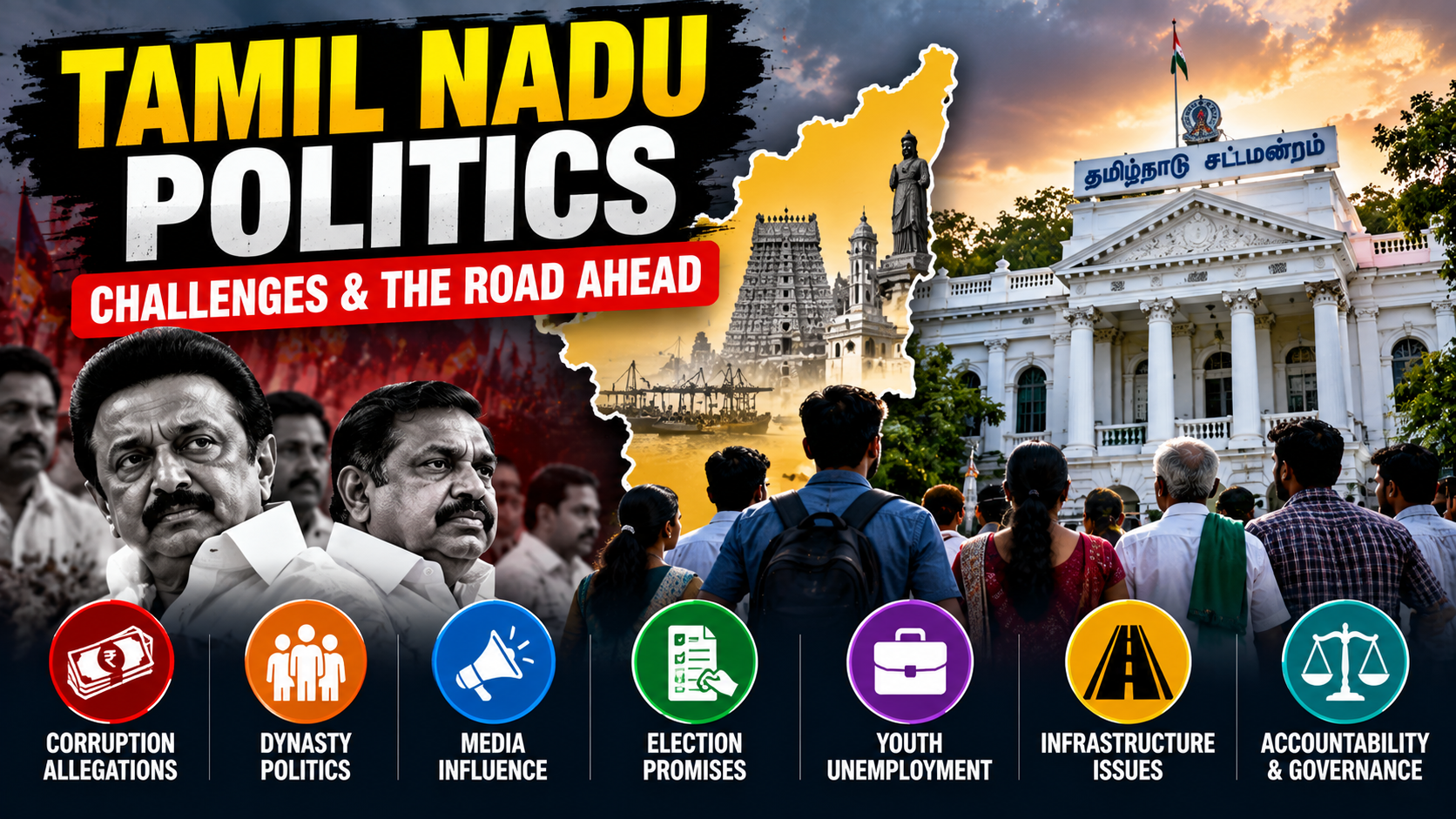
Tamil Nadu is widely recognised for its social justice movements, strong educational institutions, industrial development, and distinctive political culture. Yet, like many other states in India, it faces important political challenges that influence public trust and the quality of governance.
From corruption allegations and family-based political leadership to election promises, media influence, and unemployment, several issues continue to shape public debate. These concerns raise an important question: Is Tamil Nadu politics focusing enough on the everyday needs of its people?
Let’s examine some of the major challenges facing Tamil Nadu’s political landscape.
1. Dominance of Established Political Parties
For decades, the Dravidian movement has played a central role in Tamil Nadu politics. The DMK and AIADMK have been the state’s principal political forces since the late 1960s.
Their governments have contributed to social welfare, education, public services, and the development of Tamil identity. At the same time, the long-standing dominance of established parties raises questions about political competition, leadership renewal, and the opportunities available to emerging political movements.
The challenge: Voters need meaningful choices, credible alternatives, and parties that compete through practical policies rather than political personalities alone.
2. Corruption Allegations and Accountability
Corruption is a major concern in public life because it can divert public resources, weaken institutions, and reduce confidence in government.
Tamil Nadu’s political history includes high-profile corruption allegations, investigations, and court cases involving politicians from different parties. However, allegations must be distinguished from proven wrongdoing, and each case should be judged on its evidence and legal outcome.
Public confidence depends on transparent investigations, effective auditing, independent institutions, and consistent enforcement of the law.
The challenge: Public office must be treated as a responsibility to citizens—not as an opportunity for private gain.
3. Dynasty Politics and Leadership Opportunities
Family connections have influenced political leadership across India, and Tamil Nadu is no exception. Political families may benefit from established networks, public recognition, and organisational support.
Critics argue that this can make it harder for capable people without political connections to rise through party ranks. Supporters, on the other hand, may point to experience, public support, and organisational work as reasons for a leader’s advancement.
The important question is whether political opportunities are open to talented people from different backgrounds.
The challenge: Political parties should encourage internal democracy, transparent leadership selection, and opportunities based on ability, public service, and accountability.
4. Political Spectacle Versus Effective Governance
Tamil Nadu has a strong connection between politics, cinema, public speaking, and mass mobilisation. Political rallies and powerful campaign messages can help parties communicate with large audiences.
However, public attention can sometimes become focused on personal rivalries, dramatic statements, and political controversies instead of the practical results of government policies.
Citizens still need clear answers about employment, public transport, road maintenance, drinking water, healthcare, education, housing, and rural development.
The challenge: Political success should be measured not only by electoral victories or public popularity but also by measurable improvements in people’s lives.
5. Media Influence and Political Polarisation
Television channels, newspapers, digital publications, and social media platforms have a significant influence on political discussion in Tamil Nadu.
Political coverage can inform citizens, expose wrongdoing, and encourage debate. However, partisan reporting, misleading headlines, edited videos, and unverified claims can distort public understanding.
Social media can make the problem worse when users share political content without checking its source or context.
Citizens should compare reports from credible sources, examine original documents when available, and distinguish news reporting from opinion and political campaigning.
The challenge: A healthy democracy requires independent journalism, media transparency, and an informed public that questions claims from every political side.
6. Election Promises, Welfare Schemes, and Public Finances
Welfare schemes have played an important role in Tamil Nadu, supporting areas such as education, nutrition, healthcare, and assistance for economically vulnerable households.
Debates often arise over election promises involving cash assistance, household goods, subsidies, and other benefits. Critics question whether some promises are financially sustainable or whether they receive more attention than long-term development.
But welfare programmes should not automatically be dismissed as wasteful. Their value depends on whom they help, how effectively they are implemented, and whether the benefits justify their costs.
Governments must balance immediate social needs with investment in infrastructure, public services, skills, and employment.
The challenge: Welfare policies should be transparent, financially responsible, and evaluated according to their real impact on people.
7. Freedom of Expression and Political Dissent
Democracy requires citizens to be able to question those in power. Journalists, activists, opposition parties, students, and ordinary residents all have a role in holding public institutions accountable.
At the same time, public debate should respect the law and avoid threats, harassment, and violence.
When criticism is met with intimidation or when legitimate concerns are ignored, people may lose confidence in democratic institutions. Allegations of restrictions on dissent should therefore be examined carefully, using reliable evidence and the details of each case.
The challenge: Governments must protect lawful criticism and peaceful protest, while public institutions must respond to concerns fairly and transparently.
8. Election Money, Vote-Buying, and Political Competition
Election spending and allegations of vote-buying remain concerns in Indian politics, including in Tamil Nadu. The use of money or material inducements to influence voters undermines the principle that elections should reflect people’s free choices.
Election integrity also depends on transparent campaign financing, fair enforcement of election rules, and the ability of candidates to compete without intimidation.
Voters have an important role to play by evaluating candidates on their records, policies, and credibility rather than short-term inducements.
The challenge: Strong enforcement, transparent political funding, and informed voting are essential for fair elections.
9. Youth Unemployment and the Search for Better Opportunities
Young people are central to Tamil Nadu’s future. They need access to quality education, relevant skills, secure employment, and opportunities to build businesses.
Economic growth alone does not guarantee that every graduate will find suitable work. Differences in skills, location, wages, and access to opportunities can leave some young people frustrated despite the state’s industrial and educational strengths.
Political debates should therefore focus on job creation, vocational training, support for small businesses, industrial development, and employment opportunities beyond major cities.
The challenge: Young people need measurable outcomes—not just campaign promises about their future.
10. Infrastructure and Everyday Civic Problems
People often judge governments by the services they encounter every day: the condition of roads, the reliability of public transport, access to drinking water, waste management, drainage, and the quality of local healthcare.
Poor maintenance, delays in public projects, weak coordination, or inadequate monitoring can affect daily life even when governments announce ambitious development plans.
Local bodies and state departments need clear responsibilities, public reporting, and effective complaint-resolution systems.
The challenge: Infrastructure spending must translate into reliable services, safer streets, and visible improvements in neighbourhoods and villages.
How Can Tamil Nadu Build a Stronger Political Future?
Improving political culture requires more than replacing one party with another. Sustainable progress depends on stronger institutions and active public participation.
Some practical priorities include:
- Greater transparency: Publish accessible information about public spending, project progress, and government performance.
- Stronger accountability: Investigate credible allegations fairly and ensure that legal processes are followed.
- Better employment policies: Connect education and skills training with real opportunities in the job market.
- Responsible welfare planning: Assess the effectiveness and affordability of public assistance programmes.
- Independent journalism: Encourage evidence-based reporting and clear separation between news and opinion.
- Internal party democracy: Expand opportunities for capable leaders to emerge from different social and economic backgrounds.
- Active citizenship: Encourage voters to verify information, attend local meetings, question representatives, and participate peacefully in public life.
- Measurable governance: Evaluate political promises through outcomes in education, healthcare, infrastructure, employment, and public safety.
Conclusion: Tamil Nadu Politics Must Put People First
Tamil Nadu has a significant political and social legacy, including movements for social justice, educational development, and public welfare. Recognising its achievements does not mean ignoring its problems, just as criticising its political system does not require dismissing every contribution made by past governments.
The real concern is whether political parties consistently deliver transparent administration, economic opportunities, effective public services, and equal accountability.
Ultimately, democracy works best when citizens look beyond slogans, personalities, and party loyalties. Every government should be judged by its policies, performance, integrity, and willingness to answer difficult questions.
The most important question is not which political party wins the next election, but whether ordinary people experience better governance after it.
What do you think are the biggest challenges facing Tamil Nadu politics today? Share your views respectfully in the comments.